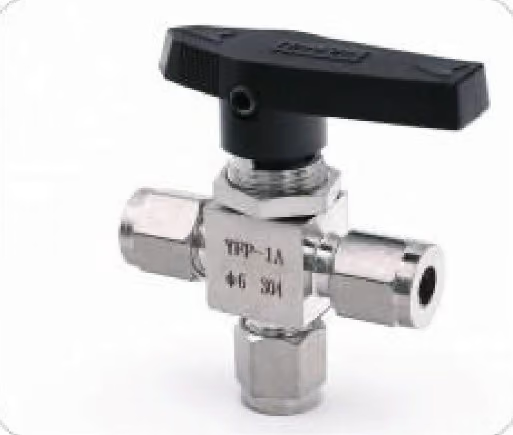
A 3-way stainless steel ball valve replaces two 2-way valves and a tee on lines that need to mix, divert or switch between two destinations. One quarter-turn of the handle changes the flow path — but only if the ball’s port pattern matches the job.
An L-port ball diverts: it connects two adjacent ports and never all three. A T-port ball can connect all three ports at once, so it mixes or splits. If the two destinations must never meet, fit the L-port.
Key takeaways
- An L-port 3-way ball valve diverts or switches flow between two adjacent ports and never connects all three, while a T-port ball can connect all three ports at once for mixing or splitting.
- If two destinations must never mix, a T-port valve is the wrong pattern regardless of price, because its mid position leaves the side ports in communication.
- 3-way ball valves are usually reduced bore, briefly connect adjacent paths during the handle turn, and should never throttle flow — a partially open ball valve cavitates and eats its seats.
Which port pattern do I need?
Settle one question first: can the two downstream lines ever be allowed to see each other? If they cannot, the answer is L-port and there is no second option.
| Factor | L-port | T-port | What decides it |
|---|---|---|---|
| Channel | 90° bend | T, all three connectable | Fixed by the ball — the handle cannot change it |
| Core job | Divert / switch | Mix / split | The process duty, not the price |
| All ports open | Never | At mid position | If all three must connect at once, only the T-port does it |
| Side-port isolation | Yes | No | The decisive row: two destinations that must never mix rule out T-port |
| Typical use | Tank selection, bypass | Blending, common outlet, sampling | Match the duty first, then check the handle stops suit the position count |
Work down the table in that order. Rows three and four decide the valve, because a T-port cannot isolate the two side ports from each other. On any duty that needs isolation, T-port is the wrong pattern regardless of price.
How does a 3-way ball valve work?
The body has three ports, usually one bottom (or side) port and two others at 90° or 180°. Inside, a ball with a shaped bore rotates in seats. A quarter turn moves the bore from one passage to the next. A half turn (180°) returns to the original path with a different intermediate position in between.
Seals at each port keep the unselected paths isolated. Like 2-way valves, 3-way bodies come in 1-, 2- and 3-piece construction, and the same pressure-class logic applies — check the rating article if you are unsure whether a standard class covers your line.
What does an L-port valve do?
An L-port ball has a 90° channel drilled through it, connecting two adjacent ports at a time. In a three-position handle the sequence runs:
- Position 1 — the bottom port flows to the left.
- Position 2 (90°) — the bottom port flows to the right.
- Position 3 (180°) — left flows to right, bottom closed.
L-port is for diverting or switching: send the incoming stream to tank A or tank B, switch a pump between duty and standby, or bypass a filter. It never connects all three ports at once, so the two destinations stay isolated.
The common stainless pattern is the bottom inlet with side outlets — our 3-way compression ball valve and female 3-way ball valve follow this layout.
What does a T-port valve do?
A T-port ball has a channel that can connect all three ports simultaneously. In its mid position, flow enters the stem port and splits to both sides — or, reversed, two streams merge into one. That makes T-port the choice for:
- Mixing: blending two feed lines into a common outlet in one valve.
- Splitting: distributing one stream to two branches proportionally, though not precisely — a ball valve is not a metering device.
- Straight-through with bypass: some T-port orientations also give a straight path plus a side take-off.
Because all three ports can communicate, a T-port valve cannot isolate the two side ports from each other. If your destinations must never mix, the pattern is wrong even when everything else on the valve is right.
What goes wrong when the pattern is wrong?
| Symptom | Most likely cause | What to change |
|---|---|---|
| Two side lines mix when they should not | T-port ball on an isolating duty | Change the ball to L-port |
| Handle will not reach the crossover position | Two-position (90°) stop instead of three-position (180°) | Specify three-position handle stops |
| Lines cross-contaminate during the handle turn | Adjacent paths connect briefly mid-turn; a 3-way valve is not a bubble-tight switcher | Add a dedicated shutoff valve per line |
| Seat edge worn, flow noisy | Valve used to throttle | Run it fully open or fully closed, or fit a needle valve for metering |
| Flow short through all three legs | Reduced-bore body | Specify full port and accept a larger, costlier body |
| Seats deformed on hot service | Wrong seat compound | Specify PTFE or filled PTFE |
The handle stops matter as much as the port: a two-position L-port valve will not give you the left-to-right crossover position. During the quarter turn between positions, flow momentarily connects adjacent paths. These are not bubble-tight switching devices, so where cross-contamination during transition is unacceptable, isolate per line instead.
How do I specify a 3-way valve on an RFQ?
Port pattern is the first line item, followed by port orientation, body construction, size, pressure class, seat material and handle stops. Send the flow diagram with the RFQ if the pattern is unusual. Five steps cover it:
- Port pattern. L or T. This decides the valve; nothing else on the RFQ compensates for the wrong ball.
- Port orientation. State which port is the inlet — any of the three can be, but bottom inlet with side outlets is the standard stainless layout.
- Body construction. 1-, 2- or 3-piece, with the size and pressure class for the line.
- Body material. SS304 for general duty, SS316/316L where chlorides or washdown are present.
- Seats and stops. PTFE or filled PTFE for heat, plus the position count the handle has to give.
Confirm each line before the drawing goes out:
- Port pattern: L or T
- Port orientation, and which port is the inlet
- Body construction: 1-, 2- or 3-piece
- Size and pressure class
- Body material: SS304 or SS316/316L
- Seat material: PTFE or filled PTFE
- Handle stops: two-position (90°) or three-position (180°)
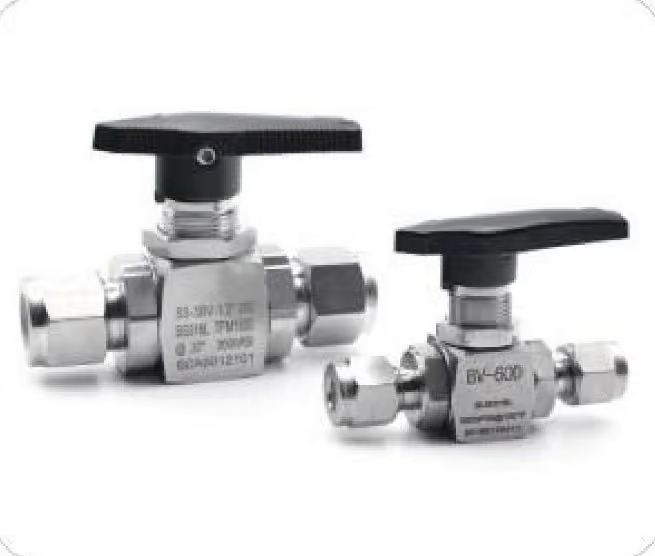
On an instrument panel with compression tubing, say so — tube-end 3-way valves differ from threaded process versions. Browse the ball valve category for the stocked 3-way range.
FAQ
Can I use an L-port valve for mixing? Only crudely, in the crossover position where left connects to right with the bottom closed. Proper mixing needs the T-port mid position where all three ports connect.
What happens to flow during the handle turn? Adjacent ports connect briefly through the ball’s channel. On clean fluids this is harmless. On incompatible fluids that must never touch, use separate 2-way valves instead.
Are 3-way valves reduced bore? Usually yes — compact 3-way bodies are commonly reduced bore. If you need full flow through all three legs, specify full port and expect a larger, costlier body.
Which port is the inlet? Any of the three can be, but seat loading and flow-induced torque differ when you feed from the stem side. Feeding the bottom port is the standard arrangement.
Can a 3-way valve throttle flow? It will, but it should not. A partially open ball valve eats the seat edge unevenly and cavitates. Run it fully open or fully closed, or fit a needle valve for metering.