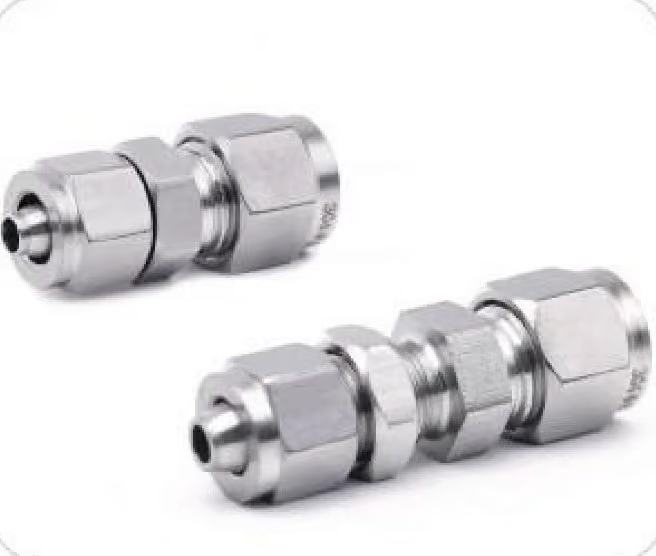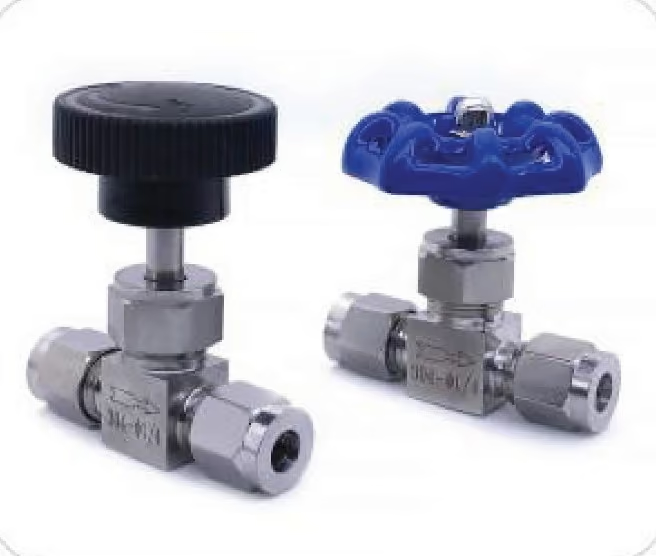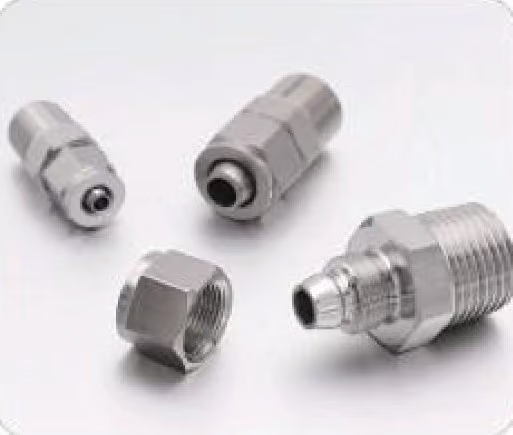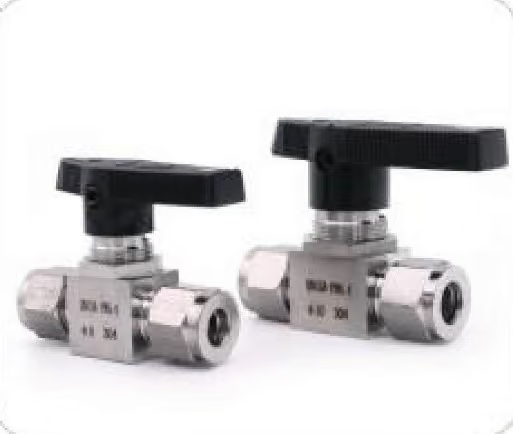
A check valve and a ball valve solve different problems on stainless tubing and pipe: one protects the line automatically, the other isolates it on command.
Fit a check valve wherever reverse flow would spin a pump backward or push product back up the line. Fit a ball valve wherever someone must shut the branch off by hand. A branch needing both gets both, in series.
Key takeaways
- A check valve opens automatically when upstream pressure exceeds its cracking pressure and closes when flow stops or reverses — no operator, no actuator; a ball valve gives manual, bubble-tight on/off isolation by quarter turn.
- Check valve types trade pressure drop against closure speed: swing designs flow freely but slam shut, while spring-loaded piston and split-disc designs close fast enough to prevent water hammer at the cost of a little head loss.
- Cracking pressure must exceed nothing and fit everything: confirm it on the RFQ, because a valve whose spring outranks your available pressure differential never opens fully, and a check valve never replaces an isolation valve upstream of open work.
Which one do I need?
| Valve | Job | Actuation | What decides it |
|---|---|---|---|
| Ball valve | Manual shutoff / isolate a branch | Quarter-turn handle | A person must operate it: maintenance, lockout, opening the line |
| Check valve | Block reverse flow automatically | Line pressure itself | No operator present: the branch must not run backward when the pump stops |
A check valve is not a substitute for isolation. If maintenance must open the line, keep a ball valve in series.
The standard layout on a branch that needs protection and maintainability is check valve plus ball valve in series. The check valve guards the branch against reverse flow around the clock; the ball valve upstream isolates it for maintenance.
Relying on the check valve alone fails twice: it is not bubble-tight under prolonged reverse pressure, and it offers no lockout for open-line work. For the isolation half of that pair, see our ball valves.
How does a check valve work?
Inside the body, a closure element — disc, piston or pair of plates — rests against a seat, held there by gravity, a spring, or both.
Forward flow must first overcome the cracking pressure: the minimum pressure differential at which the element lifts and the first flow passes. Below that differential the valve stays shut.
That is why a check valve on a low-head or gravity-fed line can throttle or block flow the designer assumed was free.
Once open, flow holds the element up. When the pump stops and flow tries to reverse, the element drops or springs back onto the seat before reverse flow establishes.
Which type fits my line?
| Type | Mechanism | Pressure drop | Closure | Mounting rule | Best fit | What decides it |
|---|---|---|---|---|---|---|
| Swing | Hinged disc swings open, gravity closes | Lowest | Slow — slams | Horizontal pipe, or vertical with upward flow | Large-bore water, low-velocity lines | Lowest head loss at a size where space is not tight |
| Spring / piston | Guided piston or disc against a spring | Higher | Fast, orientation-independent | Any orientation | Pump discharge, dosing, instrument lines | Orientation and closure speed |
| Split-disc / dual-plate | Two spring-loaded half-discs fold open | Low–moderate | Very fast | Any orientation | Compact stations, slam-sensitive systems | Space plus slam risk |
Swing designs are the old workhorse. A full-bore disc swinging open gives the lowest pressure drop of any check type.
But the same gravity-only closure slams the disc after a fast flow reversal — the classic source of water hammer — and it only works in the orientations gravity assists.
Spring-loaded piston types close quickly and work in any orientation, which is why instrument and small-bore process lines overwhelmingly use them. The spring is also what sets their cracking pressure.
Split-disc designs fold two light plates against torsion springs, closing before flow fully reverses, in a thin light body. That is the compact answer where a swing check hammers and space is short.
FerruleX’s stainless instrument range covers the spring-loaded and split-disc patterns in compression and female thread ends. Typical catalog pressure is about 2000 PSI — confirm both the pressure class and the cracking pressure on the RFQ.
Why does cracking pressure belong on the RFQ?
Cracking pressure is set by the spring — a stronger spring reseats faster but demands more upstream pressure to open.
Standard industrial check valves commonly crack in the 0.5–5 psi band, with gravity swing types at the low end and heavier spring loads higher. The right figure depends on your system’s actual differential.
Too high, and the valve chatters half-open at low flow, eating head and wearing the seat. In a dosing or gravity line it can block flow outright.
Put these on the RFQ and the factory matches the spring; do not assume the catalog default fits:
- Expected operating pressure differential, minimum and maximum
- Cracking pressure band the line actually needs
- End connection: compression or female thread
- Pressure class required, as against the roughly 2000 PSI typical catalog figure
- Mounting orientation, horizontal run or vertical with upward flow
- Flow direction as it will be piped
How do I install it the right way round?
Every check valve body is cast or marked with a flow arrow, and the valve only protects the line when it points with the intended flow.
- Read the arrow. Check the flow marking on the body against the direction the process will actually run.
- Match the orientation to the type. A swing check needs a horizontal run or vertical pipe with upward flow; spring-loaded piston and split-disc designs close by spring force and mount in any orientation.
- Mark flow direction on the PO. Put it in writing before the valve is picked, not at commissioning.
- Fit isolation upstream. Keep a ball valve ahead of the check valve so the branch can be shut and opened for work.
- Re-verify before the pressure test. Confirm the arrow once more on the installed valve, after the line is made up.
What goes wrong, and what to change?
| Symptom | Most likely cause | What to change |
|---|---|---|
| Hammer when the pump stops | Swing disc closing slowly, after flow has already reversed | Spring-loaded piston or split-disc design |
| Flow throttled or blocked on a gravity line | Cracking pressure above the available differential | Lower spring load, matched to the stated differential |
| Valve chatters half-open at low flow | Spring stronger than the line’s differential needs | Spring matched to the actual operating differential |
| No flow, though the piping looks correct | Valve installed backward | Re-check the flow arrow, then re-pipe |
| Maintenance cannot be done safely | Check valve used as the only isolation | Add a ball valve in series upstream |
| Swing check will not seat | Wrong orientation, or gravity cannot assist closure | Reorient the run, or switch to a spring-closed type |
We supply stainless steel check valves with compression or female thread ends, plus split-body styles for service. Start with the check valve category or contact for a mixed valve kit quote.
FAQ
What is cracking pressure? The minimum pressure differential between inlet and outlet at which the check valve first opens and passes flow. Spring force and seat geometry set it; below it, the valve stays shut. Confirm it on the RFQ for low-differential systems.
Can a check valve be used as an isolation valve? No. It blocks reverse flow automatically but is not designed for prolonged bubble-tight shutoff under static reverse pressure, cannot be locked out, and gives no operator control. Use a ball valve for isolation.
Which check valve type should I pick for an instrument panel? Spring-loaded piston or split-disc styles: they close fast enough to avoid slam, mount in any orientation, and come in the small compression and thread sizes panels use.
Why does my check valve hammer when the pump stops? Slow closure, the signature of a swing check on a fast-reversing line: the disc slams shut after flow has already reversed. A spring-loaded or split-disc design closes the element before reversal completes.
What happens if a check valve is installed backward? It blocks the intended flow instead of protecting it, so the line looks plumbed correctly but will not run. Verify the flow arrow on every body before the pressure test and mark flow direction on the PO.