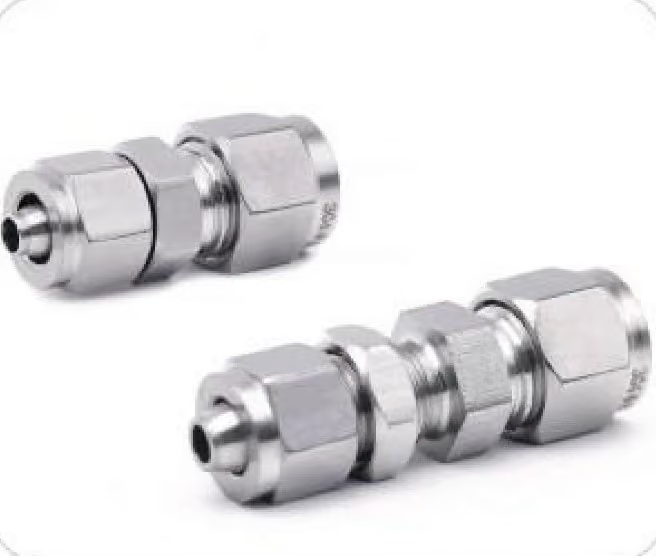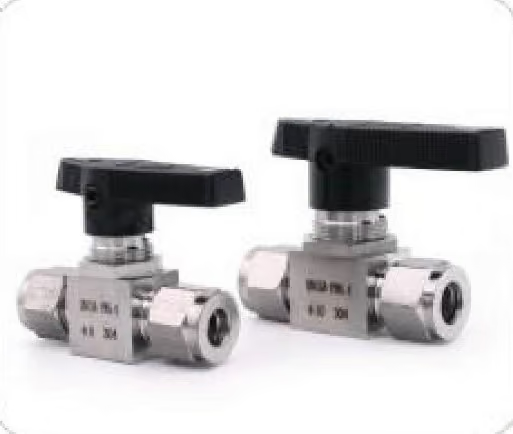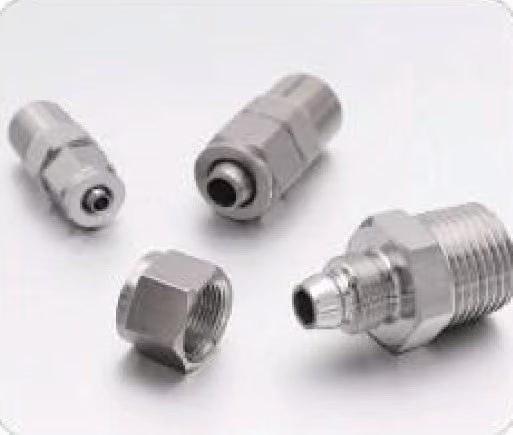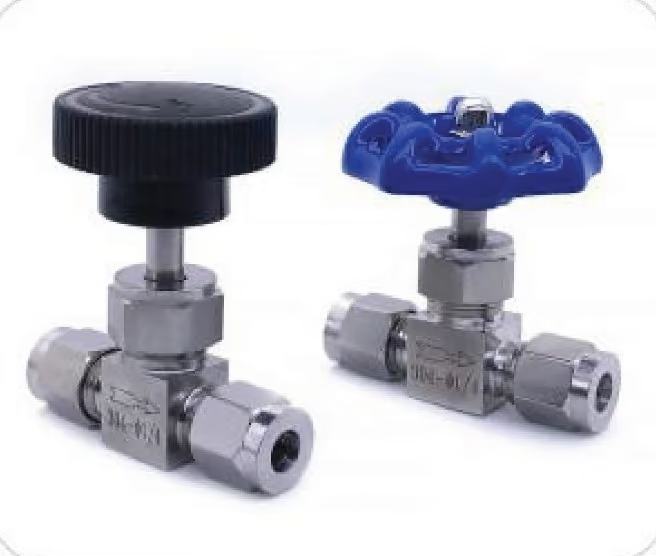
Needle valve vs ball valve is one of the most common RFQ questions on stainless manifolds — and the answer is usually settled by one word: are you throttling, or isolating?
Use a needle valve where the valve holds a setting part-open: it meters over 6–14 turns and repeats the setting. Use a ball valve where the line is only ever run open or shut: a quarter turn isolates with minimal pressure drop. Where both are needed, put the needle at the instrument and the ball upstream.
Key takeaways
- A needle valve meters: a tapered stem driven into a conical seat over 6–14 turns of handle travel gives fine, repeatable, low-Cv control — the right tool for sampling, dosing and gauge isolation.
- A ball valve isolates: a quarter turn goes from full-bore flow to bubble-tight shutoff with minimal pressure drop — but holding one part-open erodes the seat unevenly and cavitates.
- Instrumentation needle valves typically run well under Cv 1.0 and are commonly rated to 6,000 psi, with high-pressure designs to 10,000 psi — quote Cv and pressure class on the RFQ, not just the line size.
Which one do I need?
The decision is not about capacity in the abstract. Ask whether the valve ever holds a part-open setting, then whether anyone needs the line shut in one movement. Those answers point at different valves.
| Factor | Needle valve | Ball valve | What decides it |
|---|---|---|---|
| Core job | Metering and fine control | On/off isolation | Whether the valve ever holds a part-open setting |
| Operation | Multi-turn, 6–14 turns of handle travel | Quarter-turn | Whether the line has to shut in one movement |
| Flow capacity | Low — typically Cv well under 1.0 | High — a 1” full port runs Cv ~40 | The flow actually needed, then the Cv it implies |
| Pressure drop when open | High, by design | Minimal | How much pressure budget the loop can spare |
| Throttling | Purpose-built for it | Destroys soft seats; cavitates | Continuous throttling rules the ball valve out |
| Position read | Hard — count the turns | Obvious — handle aligns with the pipe | Whether position must read at a glance |
| Typical duty | Gauge isolation, sampling, dosing, calibration | Process shutoff, drains, branch isolation | The duty, settled before pressure class |
The last column is the decision. A ball valve on metering duty is being destroyed while it works; a needle valve on fast isolation duty is slow to shut, and its handle invites over-torquing. Neither is a fault of the part — both are the wrong part.
How does each valve work?
A needle valve moves a slender, taper-ground stem through a matching conical seat. The fine-pitch stem thread advances the needle a fraction of a millimetre per turn.
Flow opens through a small annular gap that closes gradually, so small handle movements give small, nearly linear flow changes. The same metal-to-metal seating shuts off completely at the bottom of the travel.
A ball valve rotates a ported ball a quarter turn between sealing seats. Fully open it offers almost no restriction; fully closed the seats isolate. There is no useful intermediate geometry — a ball valve is binary by design, which is both its strength and its limit.
What goes wrong with each one?
A ball valve parked part-open concentrates the whole pressure drop at the edge of the ball port, where flow shears across the downstream seat. The seat erodes unevenly, so shutoff tightness is gone within months. Cavitation in liquid service roughens the ball as well.
Continuous throttling is a needle valve job — or, at process-line scale, a control valve. A ball valve earns its keep fully open or fully closed.
Faults on both types come from the same three places: the duty being wrong, the handle being forced, or the line being dirty. The table matches the symptom to the cause.
| Symptom | Most likely cause | What to change |
|---|---|---|
| Ball valve will not seal after months of part-open duty | Downstream seat edge eroded by the throttling shear | Move the throttle duty to a needle valve; run the ball fully open or closed |
| Ball surface roughened, noise in liquid service | Cavitation at the part-open port edge | Stop part-open operation; the seat damage is already done |
| Needle valve weeps at full close | Stem tip deformed by over-torquing | New internals; stop forcing the handle past finger-tight |
| Needle valve weeps around the stem | Gland packing not re-snugged after the first thermal cycle | Tighten the gland packing |
| Needle valve lost fine control and behaves on/off | Weld slag or fines plugging the annular gap | A Y-strainer upstream of the valve |
| Setting drifts between operators | Valve sized so it runs near fully closed | Re-check the Cv against the flow actually needed |
Where does each one belong?
The classic needle valve home is the root of a pressure gauge, transmitter or analyzer line. Throttling there damps pulsation and lets the instrument be bled down and re-zeroed.
That is repeatable control a ball valve cannot give. The same geometry suits sampler bypass lines, chemical dosing pump discharge and calibration benches — anywhere flow is small, clean and set repeatedly.
Keep needle valves out of solids-bearing lines. One grain of weld slag or a trickle of fines plugs the annular gap, and a smoothly throttling valve becomes a binary one. A Y-strainer upstream is the cheap fix.
Where each family goes:
- Continuous metering, dosing, calibration or sampling: needle valve — and specify the Cv, not just the size.
- Gauge or transmitter isolation: needle valve at the root; add a ball valve upstream where positive process isolation is also required.
- On/off isolation, drains, full-flow branch shutoff: ball valve — see ball valve ratings and full port vs reduced port before specifying class and bore.
- Solids, slurry or scale-bearing lines: neither valve for throttling — a ball valve for shutoff only, protected from part-open operation.
How do the seats and stems differ?
Instrumentation needle valves normally seat metal-to-metal for durable shutoff. Where fine, non-galling control at the bottom of the range matters, that is a regulating stem’s job — soft-tip or non-rotating.
Ball valves on the same panel run PTFE or filled-PTFE seats. Those seats give tight shutoff and suit chemical service, and they are exactly what part-open throttling destroys.
One handling rule: a needle valve is a metering device. Forcing the handle past finger-tight deforms the stem tip, and repeatable flow is gone.
What do I put in the RFQ?
Five steps turn the duty into an order. The first decides the family; the rest fix the part.
Step 1 — decide the function. Metering or isolation settles the family before size, material or class are worth arguing about. A Cv quoted against the wrong family only makes the error more precise.
Step 2 — size on flow, then check the Cv. A needle valve normally sits well under Cv 1.0; a 1” full-port ball valve runs about Cv 40. A valve run near fully closed loses resolution, so undersizing is the common metering mistake.
Step 3 — pick the ends and the grade. Both families at FerruleX come in compression, female thread or weld-style ends depending on the SKU, in SS304, SS316 or SS316L — name both on the order.
Step 4 — fix the pressure class. Standard bar-stock needle series are commonly rated to 6,000 psi, with high-pressure designs to 10,000 psi; ball valves run 1000 WOG with reinforced 2000 and 3000 PSI classes. Our high-pressure ball valve lines match class for class.
Step 5 — ask for the Cv, then state it with the class. Manufacturers publish Cv per model. Quote Cv and pressure class on the RFQ, not just the line size.
Send these lines with the enquiry:
- Line size — the tube or pipe size the valve sits on.
- Pressure class — 6,000 psi standard, 10,000 psi high-pressure, or 1000 WOG / 2000 / 3000 PSI for a ball valve.
- Cv or flow requirement — the flow the valve has to pass, not the bore.
- End connections — compression, female thread or weld.
- Material grade — SS304, SS316 or SS316L.
- Duty — metering or isolation.
- Service note — solids, slurry or scale in the line.
FerruleX stocks stainless steel needle valves and ball valves in compression, female thread and weld ends — including the male/female straight needle valve, where one end threads straight into a manifold or header and the other takes a threaded line without an adapter.
Send those lines and we quote the right valve family, not just the cheapest one — request a factory quote.
Related reading: check valve vs ball valve and what a compression fitting is.
FAQ
Can a needle valve be used for shutoff?
Yes, at instrument scale. Metal-to-metal seating closes positively, which is why one valve can isolate and bleed a gauge line. It is slow against a quarter turn, so not the choice for fast emergency isolation.
Can I throttle a ball valve if I only need it occasionally?
Occasionally and briefly is survivable; continuously is not. Part-open operation erodes the downstream seat edge and cavitates, and the valve loses shutoff tightness long before it fails to pass flow.
What Cv should I expect from an instrumentation needle valve?
Typically well under 1.0, set by orifice diameter and stem taper. Match the Cv to the flow you actually need — undersizing is the common metering mistake. Ask for the published Cv per model on the quote.
Why does my needle valve weep at full close?
Three causes: a stem tip deformed by over-torquing, a seat galled by contamination, or packing not re-snugged after the first thermal cycle. A weep past the seat needs new internals; a weep at the stem needs gland packing tightened.
Which valve for a high-pressure instrument panel?
Both exist for the duty. Decide by function first — metering or isolation — then pressure class, and state both on the RFQ.