Stainless steel expansion joints fail in a predictable way: the joint was bought for one kind of movement and the piping delivers another. Before the RFQ, decide which of the three movements your line actually produces.
Only one of them is thermal growth of a straight run. Axial takes a single untied bellows, lateral offset wants a tied or universal two-bellows arrangement, angular rotation wants hinged or gimbal hardware. The pipe sets the type, not the catalogue.
Key takeaways
- Three movements, three joints: axial (along the pipe) is one bellows; lateral (sideways offset) wants a tied or universal two-bellows arrangement; angular (bending) wants hinged or gimbal hardware.
- Thermal growth is easy arithmetic: austenitic stainless runs ≈16.5 × 10⁻⁶/°C, so 10 m of line rising 100 °C grows about 16.5 mm — and it has to go somewhere.
- Main anchors carry pressure thrust: force = pressure × effective bellows area, plus spring and friction loads — anchoring is a design item, not an afterthought.
- Guides follow the 4D/14D rule: first guide within about 4 pipe diameters of the joint, second within about 14.
- Cycle life is a trade: EJMA-rated joints are quoted for thousands of cycles at rated movement; more travel per cycle buys fewer cycles.
Which one do I need?
Two things decide it: the direction the pipe actually moves, and whether the run is straight or already offset. Read the last column — that is the line that settles the choice.
| Movement | What the pipe does | Hardware for it | What actually decides it |
|---|---|---|---|
| Axial | Grows or shrinks along its own axis | Single untied bellows | A straight run whose only movement is growth along the axis |
| Lateral | Offsets sideways between the two end faces | Universal (double bellows with a center spool) or a tied arrangement | An offset is present at the joint, so every convolution would bend unevenly |
| Angular | Two end faces rotate to a changing angle | Hinged joint for one plane, gimbal for two | The pipes meet at a slight angle that changes with temperature |
A straight run whose only movement is growth along the axis takes a single untied bellows. Lateral and angular duty both need hardware the bare bellows does not provide.
What movement is the line actually making?
Axial is extension and compression along the pipe’s own axis — the straight-line growth of a long run heating up, or the contraction of a cold line. A single untied bellows absorbs axial movement well; that is its native job.
Lateral is sideways offset between the joint’s two ends, perpendicular to the axis. A single bellows takes only a small lateral amount — for any real offset the geometry bends every convolution unevenly, which is where the fatigue damage comes from.
Proper lateral absorption uses a universal (double-bellows with a center spool) or a tied arrangement that lets the joint shear sideways as a unit.
Angular is a rotation between the two end faces — two pipes meeting at a slight, changing angle. Angular duty needs hardware that pivots: hinged joints for one plane, gimbals for two.
Mixing them is the common mistake. Forcing a single axial joint to absorb lateral or angular movement, per expansion-joint engineering references, dramatically reduces fatigue life; a joint is “best suited to primarily axial movement.” Name the movement on the RFQ and the hardware follows.
How do I calculate the axial demand?
Growth is multiplication:
ΔL = α × ΔT × L
Austenitic stainless (304/316) has a mean coefficient of about 16.5 × 10⁻⁶ per °C across ordinary working temperatures (roughly 9–9.6 × 10⁻⁶ per °F for the 304 family).
Worked exactly as published in thermal-expansion references: 10 m of stainless, ΔT 100 °C → 10 × 16.5 × 10⁻⁶ × 100 = 16.5 mm of growth.
A 30 m steam run warming 150 °C wants nearly 75 mm of absorption — one long bellows, or several joints in series, sized off this number.
- Measure the run between anchors, in metres — that is L, the leg that feeds the joint.
- Take ΔT from installation temperature to working temperature, in °C.
- Take α as 16.5 × 10⁻⁶ per °C for austenitic 304/316.
- Multiply, ΔL = α × ΔT × L. Check against the worked case: 10 m at ΔT 100 °C gives 16.5 mm.
- Compare the result with the rated movement of the bellows, and split into several joints in series where one is short of the figure.
This is the same arithmetic behind the system thinking in why piping needs expansion joints.
How do I anchor and guide it?
An expansion joint pushes back. The pressure thrust — internal pressure acting on the bellows’ effective area, which is larger than the pipe bore — loads the first anchor with force = pressure × effective area, plus the spring force of displacing the bellows and the friction of the pipe sliding on its guides.
Anchors are engineered for that sum, and the bellows’ effective diameter, not the pipe OD, is the number to use.
Tie rods across a joint carry the pressure thrust so the anchors do not have to — but a tied joint then cannot take axial movement at all; it converts the joint into a lateral/angular device.
Guides keep the pipe straight so the bellows sees pure movement, not buckling. The standard installation rule: first guide within about 4 pipe diameters of the joint, second within about 14 diameters, with further spacing from the maker’s tables.
Skip the guides and the pressurized bellows can buckle sideways — squirm — a gross lateral shift of the convolutions that shortens life or fails outright.
What fails, and what do I change?
Read the table left to right: the sight on site, the mechanism that usually explains it, then the change that removes it.
| Symptom | Most likely cause | What to change |
|---|---|---|
| Convolutions shifted sideways as a unit | Squirm — internal pressure buckling an unguided bellows | Fit the first guide within about 4 pipe diameters of the joint, the second within about 14 |
| Cracking at a convolution after short service | An axial joint asked to absorb lateral or angular offset, so every convolution bends unevenly | Re-specify as universal or tied for lateral duty, hinged or gimbal for angular duty |
| Bellows over-extended or over-compressed | Axial demand taken from the wrong run length or the wrong ΔT | Recalculate ΔL = α × ΔT × L over the real leg, then split into joints in series |
| Anchors loaded past design | Pressure thrust not carried — pressure × effective area, plus spring and friction loads | Size the anchor for that sum, or fit tie rods and accept that axial movement is then lost |
| Correct type, short life | Cycle count never stated, so the joint runs at rated travel on every cycle | State the real cycle count and derate movement per cycle to buy cycles |
What do I put on the RFQ?
Bellows fatigue is counted in cycles. EJMA-based ratings quote joints for thousands of cycles — a common design figure is 3,000 cycles at the rated movement — and the trade is direct: more travel per cycle, fewer total cycles; derate the movement and the life climbs.
Specify the real cycle count: one thermal cycle per day for 20 years is over 7,000 cycles, which changes the joint class entirely.
Multi-ply bellows flex more per length and tolerate more cycles; single-ply runs stiffer and squirms less — a real trade-off, not a free upgrade.
Five lines carry the specification:
- Medium, pressure, temperature band — sets material and plies.
- Movement by type —
axial +20/−10 mm, orlateral ±15 mm, never just “movement 25 mm.” - Cycle count — thermal cycles per day × design years.
- Ends — flange standard or weld ends; tie rods, hinges or gimbals as applicable.
- Axial vs lateral vs angular — restated in words, because a wrong joint type voids the cycle rating.
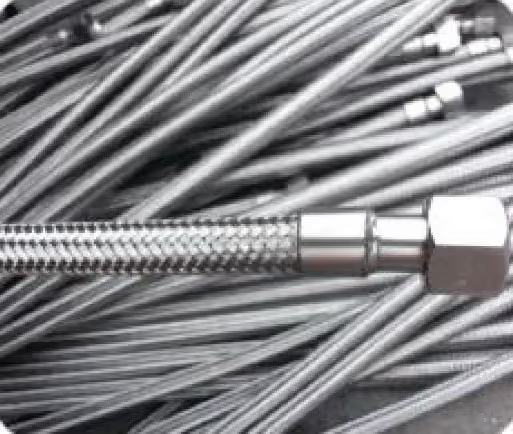
FerruleX fabricates stainless bellows assemblies and corrugated hose alternatives — see the corrugated hose range for braided-flexible duty, corrugated vs braided stainless hose for which flexibility you need, and how to specify a metal hose assembly for the braided side. Request a factory quote with the lines above.
FAQ
Can one expansion joint absorb axial, lateral and angular movement together? A single untied bellows is an axial device and tolerates only small lateral or angular amounts. Real lateral offset needs a universal or tied arrangement; real angular movement needs hinges or gimbals.
How do I calculate how much movement my pipe run produces? Multiply the coefficient of thermal expansion by the temperature rise and the run length. Austenitic stainless is ≈16.5 × 10⁻⁶/°C, so 10 m warming 100 °C grows ≈16.5 mm. Contraction on cooling counts as movement too.
What are the anchor and guide rules for expansion joints? Size main anchors for pressure × effective bellows area, plus spring and friction loads. First guide within about 4 pipe diameters of the joint, second within about 14. Tie rods carry pressure thrust but kill axial movement.
What is EJMA and why does cycle count matter? EJMA is the Expansion Joint Manufacturers Association standard practice for bellows design and rating. Joints are rated for a number of cycles at a stated movement — commonly 3,000. More travel per cycle buys fewer cycles.
What is squirm? Squirm is bellows buckling under internal pressure: the convolutions shift sideways because the effective area is larger than the pipe bore and pressure pushes them off axis. Guides, correct anchoring and correct selection prevent it.