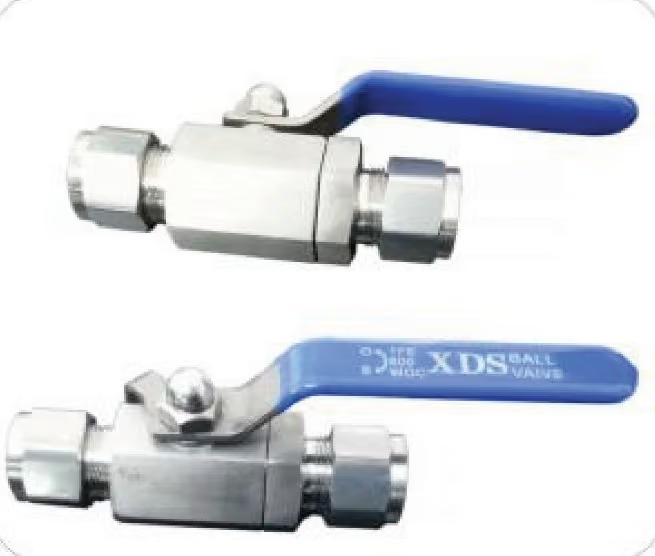
Sanitary stainless steel ball valves sell on a word that sounds like a material claim but is really a design claim. “Sanitary” does not mean “made of nice stainless” — plenty of poorly designed 316 valves fail a hygienic audit. It means the internal geometry keeps product moving, drains completely and cleans in place without harbouring residue.
A valve is sanitary when the bore matches the line, the seat leaves no cavity for residue, the body drains, and the product-contact surface is bought to a measured Ra. Standards and end types follow the duty. The alloy alone decides nothing.
Key takeaways
- Sanitary is a design property, not a grade: full-bore flow path, no dead legs or crevices, self-draining installation and a smooth product-contact surface — food and dairy work is typically specified at 32 µin (0.8 µm) Ra or better, pharma at 20 µin (0.5 µm) class.
- Two standards dominate: 3-A Sanitary Standards for dairy and food equipment, ASME BPE for bioprocessing and pharmaceutical equipment — do not quote one where the customer asked for the other.
- 316L is necessary but nowhere near sufficient: certification and geometry decide hygiene, not the alloy.
- Tri-clamp ends are the sanitary default because the joint disassembles quickly and cleans without thread crevices; threaded ends fight cleaning.
- On the RFQ, state the maximum Ra with the measurement method, the end type, the seat/seal material and the certification — not just the grade.
Which one do I need?
Start from the duty, not from the catalogue. The standard, the ends and the seat all follow what the line carries and how it is cleaned. Grade comes last: 316L is necessary and never sufficient.
Two duties cover most enquiries. Each pulls its own standard, its own end type and its own seat compound, so pin the duty down before the size:
| Duty | Standard you will be asked for | Ends | Seat | What decides it |
|---|---|---|---|---|
| Dairy, food and beverage | 3-A 68 series | Tri-clamp | EPDM | The hygienic audit the end customer runs against 3-A |
| Bioprocessing and pharmaceutical | ASME BPE, with the SF designation quoted on the drawing | Tri-clamp | PTFE for high-purity duty | The end customer quotes BPE, and the SF class fixes the surface |
Media that attack EPDM move the seat before anything else. Oils and solvents rule EPDM out, so PTFE is specified and the media list goes on the RFQ with the seal.
Where a duty mixes both worlds — a food plant with aggressive chemical washes — write both requirements and let the seal follow the media, not the standard.
What actually makes a valve sanitary?
The product-contact side is engineered around one enemy: anything the flow cannot sweep out. Four design rules follow from that, and each of them is what an auditor looks for.
- Full bore, unobstructed path. The open valve presents roughly the same cross-section as the line.
- No dead legs or crevices. Short internal transitions, and no pocket between body and seat.
- Drainability. The body, and the orientation it is installed in, must let the line empty.
- Smooth, specified surface. Product contact is bought to a measured roughness, not a grit name.
A reduced port drops velocity and leaves solids somewhere to settle. Matching the line cross-section keeps product velocity high enough to self-clean, so nothing settles in a reduced bore.
In BPE-style piping, dead-leg length is limited relative to tube diameter. The crevice between body and seat is where residue survives cleaning. Well-built sanitary ball valves use cavity-filled or encapsulated seats, so the pocket around the ball does not exist.
A valve that pools 50 mL of product is a contamination event waiting for the next batch. Self-draining geometry and minimum line slope are BPE design themes; the piping side is in tri-clamp vs threaded vs flanged.
Product-contact surfaces are polished and bought to a measured roughness, not a grit name. Dairy and food work typically lands at 32 µin (0.8 µm) Ra or better. Pharmaceutical surfaces sit at 20 µin (0.5 µm) class or finer, with electropolishing as the usual last step.
Our printable Ra surface finish chart carries the conversion and the ASME BPE surface designations. The finishing trade-offs are in electropolishing vs passivation.
Where these valves fail an audit, the symptom usually points at one cause, and the fix is a design change rather than a harder cleaning regime:
| Symptom | Most likely cause | What to change |
|---|---|---|
| Residue at swab after CIP | Cavity around the seat, or a dead leg at the valve | Cavity-filled or encapsulated seat; shorter transition |
| Line holds product after drain-down | Body not self-draining in its installed orientation | Mount at 45° for self-drain; check line slope |
| Auditor flags rough product contact | Surface bought by grit name, not measured Ra | Specify a maximum Ra with the measurement method |
| Product settles upstream of the valve | Reduced port, not full bore | Full-bore valve matching the line cross-section |
| Soil sits at the joint after cleaning | Threaded ends with spiral crevices | Tri-clamp or welded joint inside product contact |
| Seal swells or cracks in service | EPDM in oils or solvents | PTFE seat and seal for that media |
| Certificate rejected by the customer | Wrong standard quoted — 3-A where BPE was asked | Quote the standard the end customer audits against |
3-A or ASME BPE — which standard applies?
Two names come up constantly and they are not interchangeable. Ask which one the end customer audits against before anything is quoted.
- 3-A Sanitary Standards (3-A SSI). The food and dairy hygienic standard — equipment design criteria developed for regulatory acceptance in US dairy and food processing. For ball valves, the relevant document family is the 3-A 68 series. Certified products are advertised with full-bore design, cavity-filled seats and tri-clamp ends.
- ASME BPE. The bioprocessing and pharmaceutical equipment standard — design, materials, surface finish, seals and documentation. Its surface-finish designations are quoted on drawings.
The SF values are what appear on those drawings. SF1 is a mechanical polish at 20 µin (0.51 µm) maximum. SF4 is an electropolished 15 µin (0.38 µm) maximum, SF6 an electropolished 25 µin (0.64 µm) maximum, all matching the Ra chart values.
Food plants quote 3-A. Pharma and biotech quote BPE, and the SF designation travels with that quotation. Quoting one where the other was asked is a common RFQ miss, and the customer usually spots it at the certificate.
Tri-clamp, threaded or welded ends?
End choice is a cleaning decision, not a pressure one. It sets how fast the joint opens, and whether soil has anywhere to sit between washes, which is why the end type belongs in the specification.
| End | Cleaning behaviour | When it is the right call | What decides it |
|---|---|---|---|
| Tri-clamp | Apart in seconds; no thread crevices; tolerates CIP/SIP | Default for sanitary lines | The line must open for inspection |
| Threaded | Spiral leak paths and root crevices that manual cleaning misses | Outside product contact only | Never in a product zone |
| Welded | Cleanest joint, permanently closed | Lines that never need to open | The line never opens |
The tri-clamp default is two ferrules, a gasket and a clamp. Threaded ends are the opposite story — cheaper and faster to assemble, which is why food lines still avoid them. Welded ends are permanent and the cleanest of all.
The full comparison is in tri-clamp vs threaded vs flanged for sanitary lines. Our tri-clamp hose assemblies are the flexible-joint side of the same system, in the corrugated hose range.
Which seat and seal do I fit?
Seal material follows the media, not the drawing title. EPDM is the food-and-steam default: hot water, CIP and SIP cycles, dilute acids. PTFE handles aggressive chemicals and high-purity duties.
EPDM degrades fast in oils and solvents; PTFE costs more and runs colder on steam. Write the media with the seal on the RFQ, so the supplier is not left choosing for you.
The same media-first logic governs the gasket in every tri-clamp joint around the valve. Compound-by-compound temperatures are in tri-clamp gaskets: sizes and materials.
What do I write on the RFQ?
A complete enquiry has five parts. Miss one and the supplier guesses, and the guess is what the audit later finds, usually at the swab rather than at goods-in.
- Step 1 — name the standard. 3-A 68 series or ASME BPE with the SF designation, the one the end customer audits against.
- Step 2 — write the maximum Ra. Product-contact Ra with the measurement method stated, and the polish noted where the band is fine.
- Step 3 — fix the ends and the size. Tri-clamp 1.5 in on the example line below, with threaded and welded ends only where the duty allows them.
- Step 4 — specify the seat and seal. By construction and compound: cavity-filled PTFE, or EPDM for steam and CIP duty.
- Step 5 — state the installation. Mount at 45° for self-drain wherever the line has to empty between batches.
Run this checklist before the enquiry goes out. Every line has to be answered rather than left implied:
- The standard and its designation
- Maximum Ra plus measurement method
- End type and size
- Seat construction and seal compound
- Wetted grade, 316L for product contact
- Drainage and mounting orientation
- The certification the line must satisfy
| Line | Example | Why |
|---|---|---|
| Standard | 3-A 68 series or ASME BPE SF4 |
The certification the line must satisfy |
| Surface | product-contact Ra ≤ 20 µin (0.51 µm), EP, method stated |
Maximum Ra plus how it is measured |
| Ends | tri-clamp 1.5 in |
Cleaning and disassembly behaviour |
| Seat/seal | cavity-filled PTFE |
Crevices and media resistance |
| Grade | 316L wetted parts |
Corrosion boundary |
| Drainability | mount at 45° for self-drain |
Installation, not just hardware |
FerruleX builds stainless sanitary and food-duty valves with the surface and end written line by line. Start from the corrugated hose assemblies for tri-clamp connections, see how food-grade specs actually read in sanitary stainless fittings, and request a factory quote with the table above.
FAQ
Is 316 automatically sanitary? No. The grade sets corrosion resistance only; hygiene comes from geometry, surface finish and certification. A well-designed 304 out-performs a rough, dead-legged 316 in food duty, so certify the design rather than the grade name.
3-A or ASME BPE — which do I ask for? Ask what the end customer requires. 3-A covers dairy and food equipment design; ASME BPE covers bioprocessing and pharmaceutical equipment, including its SF surface designations. Quoting one for the other’s application is a common miss.
What Ra should I specify for a sanitary ball valve? Food and dairy is typically 32 µin (0.8 µm) or better; pharmaceutical 20 µin (0.5 µm) class or finer, commonly electropolished. State the maximum Ra with the measurement method — grit names drift, as the Ra chart warns.
Why do sanitary valves avoid threaded ends? Threads create spiral crevices that soil lodges in, where cleaning cannot reliably reach. Tri-clamp joints come apart crevice-free; welded joints remove the joint. Threads survive only outside product contact.
EPDM or PTFE seats for sanitary service? EPDM for steam, hot water and CIP/SIP duty — the food-and-beverage default. PTFE for aggressive chemicals and high-purity media. Check the media list first: EPDM fails in oils and solvents.