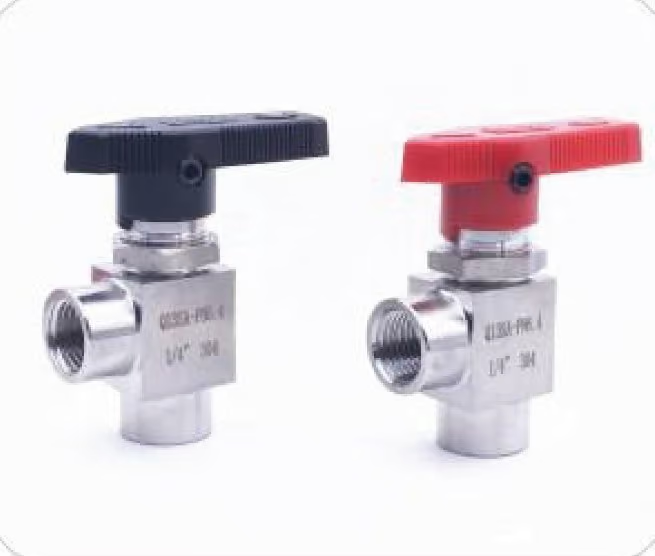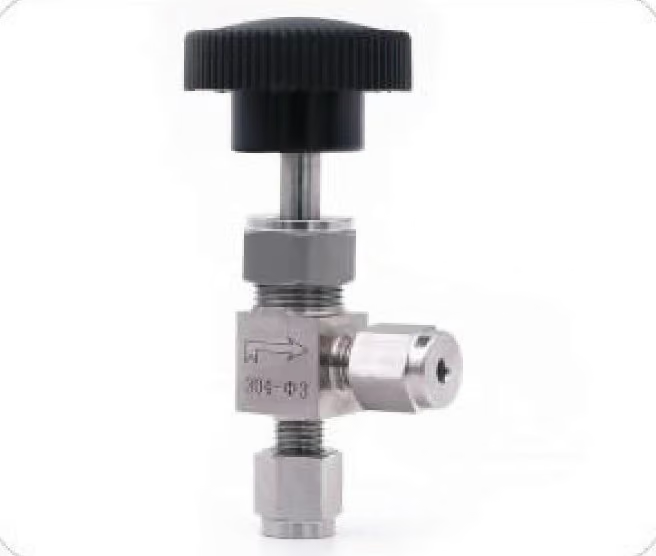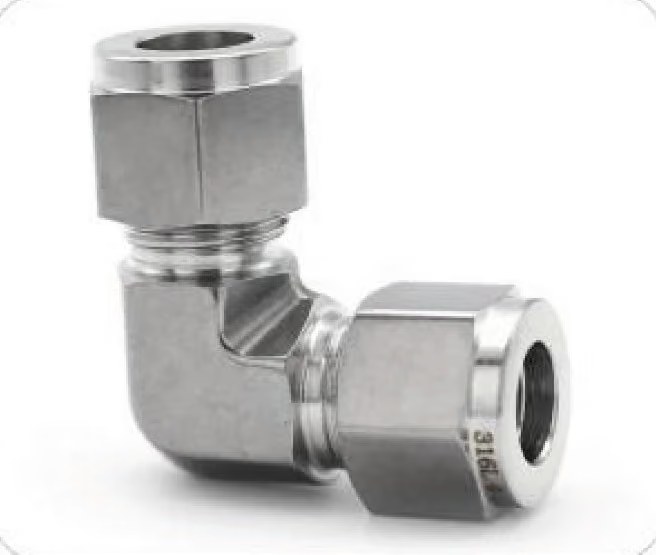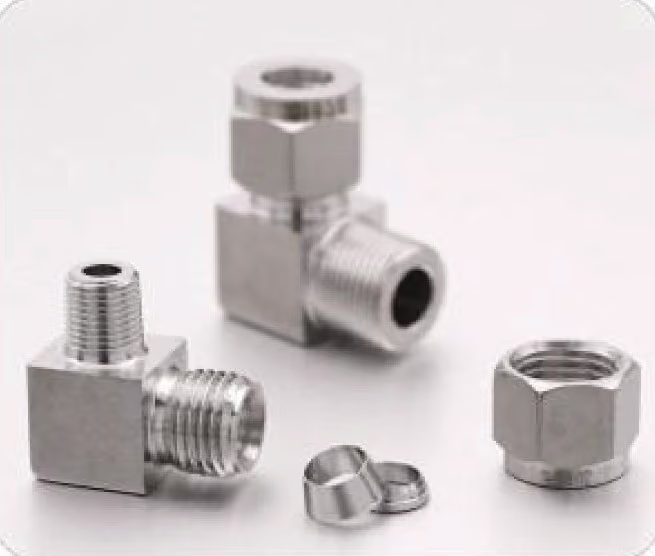
SS304 and SS316 are mechanically near-identical; 316 adds 2–3% molybdenum, and that single element decides the choice. Buy 304 where chlorides never reach the line. Buy 316 where they do, and 316L where the assembly is welded.
Key takeaways
- The only compositional difference that matters between SS304 and SS316 is 2–3% molybdenum in 316, which lifts its pitting-resistance number (PREn) from ~18–20 to ~24–26 — negligible in clean air and water, decisive in chlorides.
- Both grades share essentially the same strength and fabricability; SS316L caps carbon at 0.03% versus the 0.08% standard maximum to stop weld decay in the heat-affected zone of welded assemblies.
- Expect SS316 to cost roughly 30–40% more than SS304 — money well spent on marine splash, chemical dosing and chlorinated CIP, and wasted on dry indoor instrument air.
Which one do I need?
Start from the media rather than the price. Where chlorides never reach the fitting, the two grades age identically and 304 is the correct line item. Where they do reach it, molybdenum is the only thing between the fitting and a pitting failure.
| Duty | SS304 | SS316 / SS316L | What decides it |
|---|---|---|---|
| Dry indoor instrument air, OEM panels, utility skids | Correct | No benefit | Whether chlorides ever reach the line |
| Plant water with low chloride, hydraulic oil | Correct | No benefit | Chloride content of the water |
| Marine splash, coastal air, de-icing salt | Pits eventually | Minimum sensible grade | Chloride exposure, not pressure |
| Chemical dosing, hypochlorite, chlorinated cleaning | Pits — no polish will save it | SS316L | Chlorides plus the cleaning regime |
| Welded assemblies in corrosive service | 0.08% carbon, weld-decay risk | 316L at 0.03% carbon | Whether the joint is welded |
| Shelf stock | Broadest size range | Common sizes, less deeply | How unusual the size is |
| Material cost | Baseline | Roughly 30–40% more | Whether the duty needs the margin |
Pressure, size and finish are not the deciding column. Chloride exposure is, followed by whether the joint ends up welded.
What actually differs between them?
Both grades are austenitic 300-series steels. In the annealed condition their working strength is nearly identical, and they weld, bend and machine the same way. What separates them is small and specific:
| Element | SS304 | SS316 |
|---|---|---|
| Chromium | 18.0–20.0% | 16.0–18.0% |
| Nickel | 8.0–10.5% | 10.0–14.0% |
| Molybdenum | none | 2.0–3.0% |
| Carbon (max) | 0.08% | 0.08% |
| Typical PREn | ~18–20 | ~24–26 |
Everything else in the specification — tensile properties, hardness, forming behaviour — overlaps enough that drawings rarely distinguish the grades on mechanical grounds.
Does PREn actually predict pitting?
Engineers screen chloride resistance with the pitting resistance equivalent number, PREn = %Cr + 3.3 × %Mo + 16 × %N. SS304 sits around 18–20. SS316, carrying molybdenum, sits around 24–26 — a 6–8 point gap in resistance to pitting and crevice corrosion.
Treat PREn as a screening tool, not a guarantee. Surface finish, crevices, stagnant warm zones and weld quality all move real performance. But as a first filter it is honest — a 304 fitting in a chloride service pits eventually, and no polish will save it.
The chloride services that matter here are wider than seawater:
- Seawater and marine splash
- Coastal air
- De-icing salt
- Hypochlorite dosing
- Aggressive chemical cleaning
Where does SS304 hold up, and where does 316 pay for itself?
SS304 covers dry indoor instrument air, plant water with low chloride content, hydraulic oil lines, most OEM panels and general utility skids. In those duties 304 and 316 age identically, so the cheaper grade wins, and specifying 316 is insurance you never claim on.
SS304 is also the volume grade. Factories machine, cast and stock it in the largest quantities, so shelf depth is deepest and the widest size range is available off the shelf.
SS316 belongs on marine splash zones and coastal installations, chemical dosing skids, chlorinated cleaning regimes and pharmaceutical or high-purity water loops. It also covers food, beverage and pharma lines running chloride-bearing CIP chemicals, where the surface finish the process demands goes on the order with the grade. There the molybdenum slows pitting initiation enough to matter in service, not just on datasheets.
For welded assemblies in corrosive service, specify 316L rather than standard 316. Welding holds the heat-affected zone in the temperature window where carbon precipitates chromium carbides at the grain boundaries.
That leaves a narrow band beside the weld depleted of chromium — classic intergranular weld decay. The L grade caps carbon at 0.03%, starving that reaction, so weld-end fittings, welded manifolds and fabricated spools that see chlorides carry 316L.
Expect 316 barstock and castings to run roughly 30–40% over 304, tracking nickel and molybdenum prices. The gap widens when alloying metals spike and narrows when they soften, so treat any fixed percentage as a snapshot.
Factory stock mirrors demand. 304 compression fittings and valve bodies cover the broadest range from the shelf, 316 and 316L common sizes are stocked less deeply, and odd 316L sizes may need a mill run.
What fails if you pick the wrong grade?
Chloride failure is slow, then sudden. The symptom usually shows at a joint or a low point that stayed wet, and the correction is a grade change rather than a tighter torque.
| Symptom | Most likely cause | What to change |
|---|---|---|
| Pitting and crevice corrosion in splash or washdown | 304 in chloride service, with no molybdenum | Move the line item to 316 |
| Pitting under a salt deposit that stayed damp | Chlorides concentrated in a stagnant zone | 316, plus rinsing and draining |
| Intergranular attack in a narrow band beside the weld | 0.08% carbon precipitating chromium carbides in the heat-affected zone | Change to 316L at 0.03% carbon |
| Magnet test suggests “316” but proves nothing | Both grades are non-magnetic annealed and slightly magnetic cold-worked | XRF analysis, and mill certificates |
| Quote reads “stainless” with no grade | Grade never written on the RFQ | Re-quote with the grade against each item |
| Budget drifts between orders | The 30–40% gap tracks the nickel and molybdenum market | Treat the percentage as a snapshot, confirm current material |
How do I write the grade on the RFQ?
A grade is a line item, not a note. Work it in this order.
- Read the media and the environment. Note chlorides, splash, cleaning chemicals and any zone that stays wet between cycles.
- Set the base grade. No chlorides in the duty means 304; chlorides present mean 316.
- Check for welds. If the assembly is welded into corrosive service, the line item is 316L, not standard 316.
- State the grade against every item. A factory should never silently downgrade a 316 line to 304 to hit a price.
- Ask for mill certificates where the grade matters, and pass on any XRF result you already hold.
Before the enquiry goes out, the specification should carry:
- The grade, written against each line item — not “stainless”
- Tube OD or thread size
- Quantity
- Whether the item is welded into an assembly
- The surface finish the process demands
- Whether mill certificates are required
FerruleX machines and stocks stainless steel compression fittings, ball valves and needle valves in SS304, SS316 and SS316L, with mill certificates on request. Send the grade, tube OD or thread size and quantity. A printable version of the grade comparison is on our stainless steel grades chart sheet.
FAQ
Is SS316 stronger than SS304? No meaningful difference in the annealed condition — tensile and yield values overlap. You buy 316 for corrosion resistance, not strength. For strength, look at duplex or cold-worked grades.
Can I use SS304 fittings on a boat or dockside line? Not for anything seeing seawater splash, spray or coastal air long-term. 304 pits and crevice-corrodes in chlorides, so 316 is the minimum sensible grade. Even 316 needs rinsing and no stagnant salt deposits.
What does the L in SS316L do? It caps carbon at 0.03% against 0.08% in standard 316. Low carbon stops chromium carbide precipitation in the weld heat-affected zone, so the joint keeps its corrosion resistance without post-weld annealing.
Will a magnet tell 304 from 316? No. Both are essentially non-magnetic annealed and slightly magnetic when cold-worked. XRF analysis separates them reliably, and mill certificates settle it where the grade matters.
Is the price gap between 304 and 316 fixed? No. It tracks the nickel and molybdenum markets, so it moves monthly. Roughly 30–40% is a common planning figure, but confirm current material for budget work.