Pitting corrosion is the localized attack that lets chloride solutions bore small, deep cavities into stainless steel while the surrounding surface stays bright. It is the failure mode that catches fitting buyers most often, because a fitting can look fine and still be perforated.
Pits start where the passive film breaks down, and they grow fastest exactly where fittings are weakest: at crevices, threads and deposits. Grade sets the resistance, design sets where the attack lands, and maintenance decides whether chlorides stay concentrated. 316 resists better than 304, but it is not immune.
Key takeaways
- Pitting is localized chloride attack: the passive film breaks at a weak point, the pit interior turns acidic, and the pit grows while the rest of the surface stays passive — 316 resists it better than 304 but does not become immune.
- Pitting resistance scales with alloy content: PREN = %Cr + 3.3 × %Mo + 16 × %N puts 304 around 18–21 and 316/316L around 23–29 — approximate ranges, since composition varies by heat.
- Warmth, chlorides and crevices multiply each other: the ferrule seat and the thread roots of a fitting are pitting hotspots by design.
- Prevention is grade plus design plus maintenance: pick the grade for the chloride level, eliminate crevices and dead legs, and keep surfaces clean.
Which grade do I need?
The screening number is the pitting resistance equivalent number, PREN = %Cr + 3.3 × %Mo + 16 × %N, using the alloy’s weight percentages. It ranks alloys against each other; it does not measure one fitting. The published approximate ranges:
| Grade | Approximate PREN | What actually decides it |
|---|---|---|
| 304 | 18–21 | Base austenitic; chlorides pit it readily, so it needs a low chloride duty |
| 316 | 23–28 | Molybdenum lifts the range well above 304; the usual chloride-service grade |
| 316L | 23–29 | Same pitting class as 316 — the L is about carbon, not pitting |
Two honest caveats. The ranges are wide because composition varies heat by heat. And PREN is a ranking, not a guarantee: a 316 fitting in warm, stagnant, concentrated chloride service can still pit, which is why continuously wetted seawater and brine duty belongs to duplex grades.
That boundary is spelled out for buyers on the water treatment and chemical processing pages. The grade logic that puts 316 into chloride service at all is covered in SS304 vs SS316.
Some variants weight nitrogen at 30 instead of 16, and tungsten-bearing alloys add a W term, so treat PREN as a comparison tool, not a property.
How does a pit start and grow?
Stainless steel resists corrosion because chromium forms a thin, self-repairing oxide film. Chloride ions attack that film at its weakest points — a scratch, an inclusion, a deposit, a crevice — and where the film fails, the exposed metal starts dissolving.
The chemistry then turns against the steel. Metal dissolving inside the pit makes the pit solution acidic, chloride migrates in to balance the charge, and the acid-chloride brew inside prevents the film from reforming.
The pit becomes self-sustaining and grows deep while the surrounding surface stays passive and shiny. That is what makes pitting insidious on fittings: the first sign is often a weep at the joint, not a rusty surface.
Temperature raises the risk, and so does anything that lets chlorides concentrate: crevices, dead legs, thread roots, debris.
Where do fittings fail first?
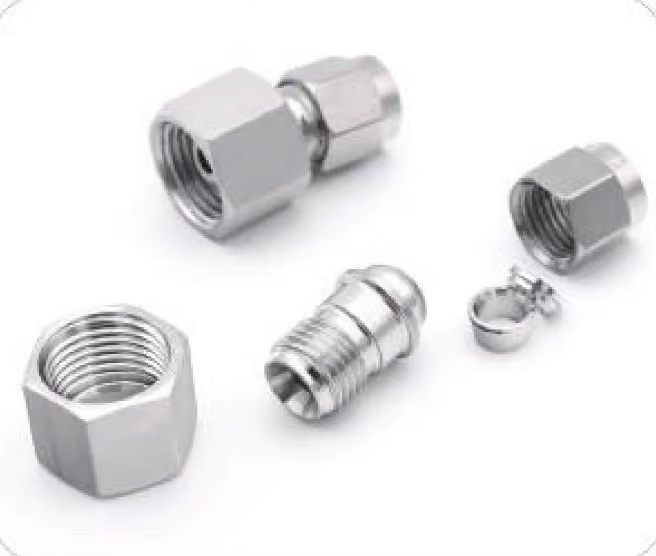
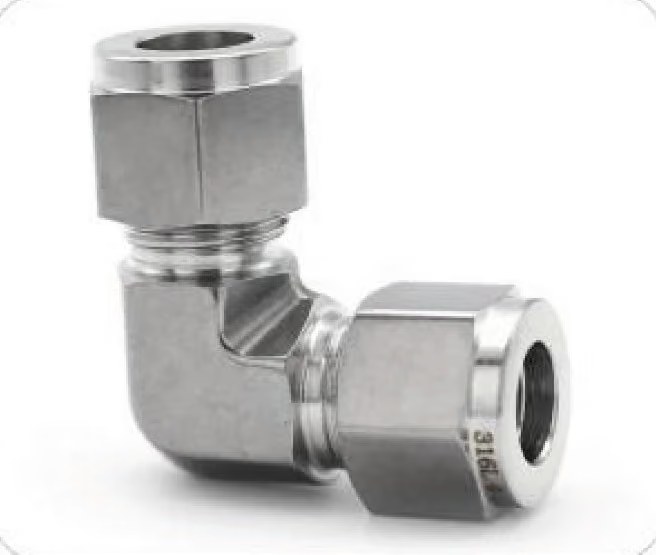
On a compression fitting the classic hotspot is the ferrule seal zone, where moisture can sit. On threaded fittings it is the NPT or G thread root, where sealant and crevice meet. Weld zones and the area under deposits follow.
| Symptom | Most likely cause | What to change |
|---|---|---|
| Weep at the joint, bright metal around a small dark cavity | Pitting through the ferrule seat | Remake or replace the joint; cut the chloride level at source |
| Rust staining around a thread root | Chlorides held in the thread engagement under sealant | Seal or eliminate the crevice; raise the alloy if the level stays |
| Pits under a scale or debris patch, clean surface elsewhere | Crevice corrosion in the stagnant gap under the deposit | Keep surfaces clean and flowing; remove the deposit |
| Attack where stainless meets carbon steel or copper | Galvanic corrosion, the less noble metal eaten | Isolate the two metals; keep the pair out of one electrolyte |
| Crack at a bent tube or cold-worked thread in hot chloride duty | Stress corrosion cracking from stress plus chlorides plus heat | Anneal or stress-relieve; lower chloride, temperature or stress |
| Wall lost at one point on a thin-wall body that still looks sound | Localized pitting on an instrument fitting | Replace it, and inspect at every remake |
Which of the four corrosions is it?
Pitting rarely travels alone on a fitting. The other three modes below run alongside it in the same service, and one joint can show two of them at once.
| Corrosion | Trigger | Where it shows up | First defense | What decides it |
|---|---|---|---|---|
| Pitting | Chlorides at a film-breakdown point, worsened by warmth and deposits | Ferrule seats, thread roots, weld zones, under deposits | Raise alloy (316 over 304), keep surfaces clean and flowing | Chloride level at temperature, then the grade |
| Crevice corrosion | Chlorides concentrating in a tight gap with stagnant fluid | Thread engagements, gasket interfaces, under scale or debris | Eliminate or seal crevices; design drainage into the run | Whether the design can keep the gap wetted and drained |
| Galvanic corrosion | Two disjoined metals in one conductive fluid, the less noble one eaten | Stainless against carbon steel supports, copper, or wet insulation | Isolate the metals; keep the pair out of one electrolyte | Whether two metals share the electrolyte at all |
| Stress corrosion cracking | Tensile stress plus chlorides plus elevated temperature | Bent tube, cold-worked threads, stressed welds in hot chloride service | Anneal or stress-relieve; lower chloride, temperature or stress | Stress state plus temperature, not grade alone |
How do I stop it starting?
Prevention is three levers together: grade selection matched to the chloride level, design that avoids crevices and stagnant zones, and maintenance that keeps chloride deposits off the surface. In practice it runs as a sequence.
- Establish the chloride exposure. What the medium carries, and at what temperature, sets the risk; warmth and evaporation both concentrate the chlorides.
- Screen the grade by PREN. 304 sits at 18–21 and 316/316L at 23–29, so the molybdenum grades are the starting point once chlorides are present.
- Find the crevices before the drawing is released. Ferrule seat, thread root, gasket interface and dead leg each hold stagnant fluid.
- Design the drainage. Slope the run so the fitting does not sit as a sump, and delete dead legs where chlorides can concentrate.
- Inspect at every remake. Look at the ferrule seat and the thread root while the joint is open.
Specification checklist for a chloride-service fitting:
- Grade named per line on the RFQ, not “stainless” alone.
- Chloride level and temperature stated alongside the size list.
- Ferrule seat and thread root reviewed on the drawing for a trapped gap.
- Dead legs and low points removed from the line.
- Surfaces specified clean and flowing, with deposits removed in service.
- Passivation specified after fabrication; it restores the film on a clean surface but does not repair pits already formed.
Why does a pit matter for leak integrity?
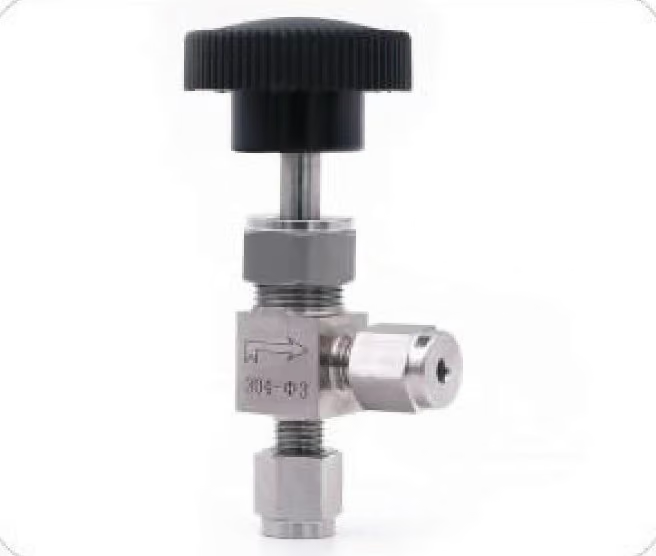
A pit in a fitting is not a cosmetic flaw. Instrument fittings are thin-walled, high-integrity parts: 1/8 inch tube ferrules, needle-valve stems, gauge snubbers. One deep pit through a ferrule seat or a valve-body wall becomes a leak path, and on gas service a pit leak drifts the measurement before it drips on the floor.
The maintenance answer is unglamorous: keep chloride off the surface, keep crevices out of the design, and inspect at every remake. If a fitting shows staining around the seat, treat it as a suspect joint, not a dirty one.
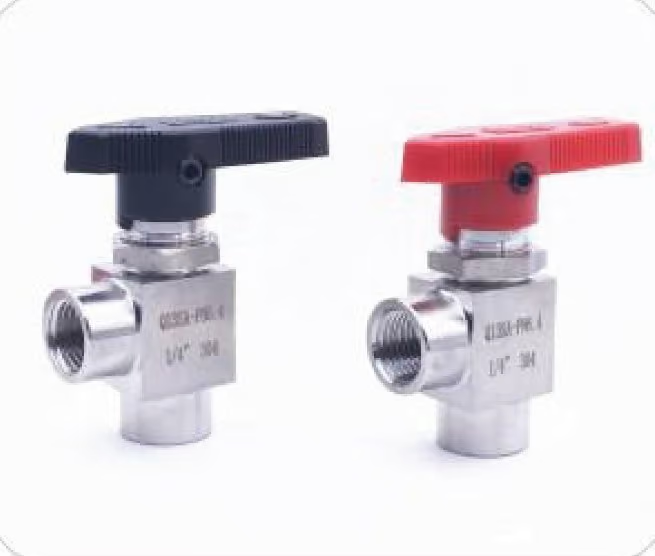
FerruleX quotes 316 and 316L compression fittings, needle valves and check valves for chloride service. The grade is named on the RFQ per line: state the chloride level and temperature alongside the size list, and we quote the grade that matches rather than the grade in stock. Request a factory quote.
FAQ
Does 316 stainless steel rust? It can. 316 resists chloride pitting better than 304 because of its molybdenum, but it is not immune; in warm, stagnant or concentrated chlorides it can pit and show rust staining around the pits.
Does stainless steel rust in saltwater? Yes — all common austenitic grades can. Continuously wetted seawater is among the most aggressive chloride services, and 316 and 316L pit and crevice-corrode in it, which is why duplex grades are standard there.
Is pitting corrosion dangerous? It is the most dangerous common mode for thin-walled parts because it is hidden and local. A fitting can lose most of its wall at one point while looking serviceable, then fail as a leak at pressure.
What prevents pitting corrosion on stainless fittings? Grade selection matched to the chloride level, design that avoids crevices and stagnant zones, and maintenance that keeps chloride deposits off the surface. Passivation restores the film after fabrication but does not repair pits already formed.
Will passivation stop pitting that has already started? No. Passivation restores the passive film on a clean surface and removes free-iron contamination; it cannot replace metal already lost. Pitted surfaces need qualified rework or replacement, then the environment addressed.