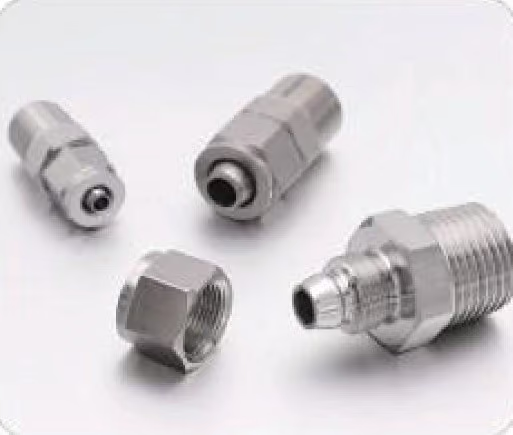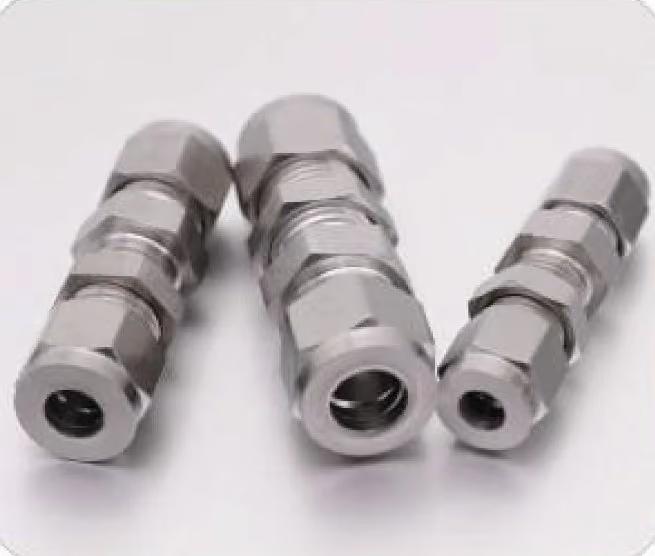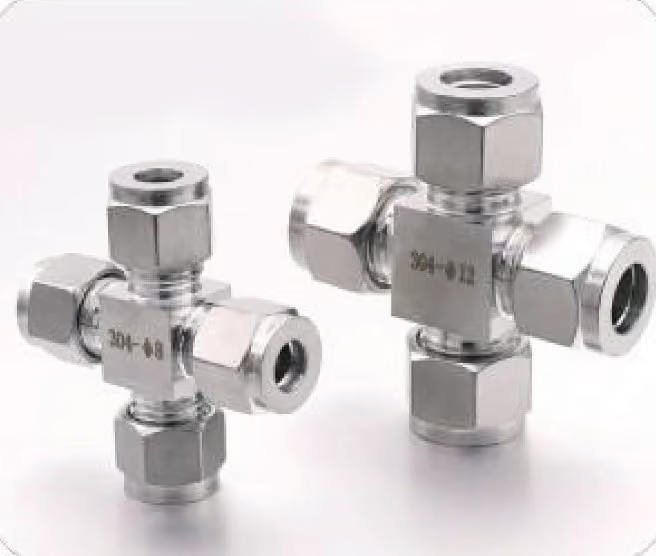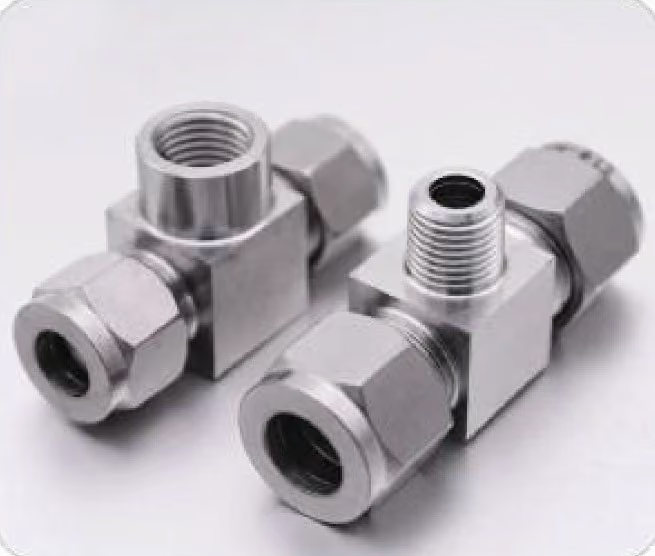
A ferrule is the small metal ring that makes a compression fitting seal — the component that actually bites into the tube and locks the joint.
In a ferrule fitting, the nut drives that ring into the body cone and the ring’s edge displaces tube metal to seal and grip in one stroke. The ring is single-use and must be harder than the tube it bites. A double-ferrule set splits the two jobs between a front ring and a back ring.
Key takeaways
- A ferrule is a single-use metal ring that the fitting nut swages into the tube surface: the bite displaces tube metal to create a pressure-tight seal and mechanical grip in one deformation.
- In a double-ferrule set, the front ferrule forms the primary seal against the body while the back ferrule grips the tube against pull-out and absorbs vibration.
- A ferrule must be harder than the tube it bites, and ferrules deform permanently on first makeup — replace them at every remake and never mix brands in one fitting.
Which ferrule set do I need?
The choice is a single ring or a split pair, and the line settles it. Stationary runs take the single ring; vibrating instrument lines take the pair.
| Set | What it does | Decisive: choose it when |
|---|---|---|
| Single ferrule | One ring forms the seal and grips the tube | The line is stationary, so one ring can do both jobs |
| Double ferrule | Front ring seals against the body; back ring grips the tube and flexes | The line vibrates and gets remade; the back ring takes the abuse so the front keeps sealing |
A single-ferrule design asks one ring to do both jobs and does it well enough on stationary lines. The split design is what makes the joint forgiving on vibrating instrument panels — the back ferrule takes the abuse so the front ferrule keeps sealing.
How the complete joint goes together around these rings is covered in what is a compression fitting, and the pattern-level choice in single ferrule vs double ferrule.
What does the ferrule actually do?
When the nut tightens, the ferrule is driven into the body cone, which squeezes it onto the tube surface.
Two things happen in that single stroke. The ferrule’s leading edge bites, displacing a controlled ridge of tube metal; its face is pressed into a matching cone in the body to form the seal.
The displaced tube metal locks into the ferrule’s groove, so the joint resists both pressure and pull-out mechanically. No sealant is involved — the seal is cold metal deformed against cold metal.
That is why the joint survives vibration and remaking better than anything relying on tape or compound.
What do the front and back ferrules each do?
In a double-ferrule set the two rings divide the labour, and that division tells you which ring to blame when a joint fails.
| Ring | Role | What it forms or grips | Failure if worn | Decisive: what to change |
|---|---|---|---|---|
| Front ferrule | Conical ring facing the body | The primary metal-to-metal seal against the body seat; takes the first share of the sealing load | The joint loses its primary seal | Fit a new front ferrule; check the body seat before reuse |
| Back ferrule | Ring behind it, driven forward by the front | Swages harder onto the tube; grips against pull-out and flexes to absorb vibration so the primary seal is not worked loose | Grip against pull-out is lost and vibration reaches the seal, working it loose | Fit a new back ferrule, and cut the tube back before reassembly |
A joint that weeps at the body points at the front ring. A tube that pulls out, or a seal that works loose under vibration, points at the back.
What goes wrong, and what do I change?
Most ferrule faults reduce to three causes: wrong hardness, reused rings, mixed parts. Read the symptom, then change the one thing that caused it.
| Symptom | Most likely cause | What to change |
|---|---|---|
| Joint leaks no matter how tight the nut goes | The ferrule is not harder than the tube, so it skates instead of biting | A harder ferrule set, or annealed tube |
| Joint weeps on gas service and never grips | Hard hydraulic tube — the ring never gets its bite | Annealed stainless tube, with the ferrule set matched to it |
| Tube pulls out under pressure | No bite: the ring deformed instead of locking into the tube surface | A harder ferrule set and a freshly cut tube |
| Tube surface scored or cracked under the ring | Ferrule harder than the tube, as with a stainless ring on copper | Brass ferrules on copper tube |
| Seal works loose on a vibrating line | One ring doing both jobs, or a back ferrule that has stopped gripping | A double-ferrule set with a new back ferrule |
| Joint leaks after a remake | Old ferrules reused and sealing on damaged geometry | New ferrules, and the tube cut back to undamaged section |
| Leak at best, pulled joint at worst after a repair | Mixed-brand parts in one fitting | A complete set from one brand |
Tightening harder fixes none of these. A ring that never bit only keeps leaking, because the seal never formed.
How do I match ferrule to tube and media?
A ferrule must be harder than the tube it bites, or it cannot swage and lock — it skates on the surface and the joint leaks no matter how tight the nut goes.
Fully annealed stainless tube is the default for instrument work: soft enough to accept the bite, strong enough to hold pressure.
Hard hydraulic tube is the classic failure — the ferrule never gets its grip and the joint weeps on gas service. If tube hardness is unknown, say so on the RFQ; it changes the recommended ferrule set.
Ferrule material follows the tube and the media.
| Material | What it suits | Decisive: the tube or media that calls for it |
|---|---|---|
| SS304 | General duty on SS304 tube | The tube is SS304 and the media is not aggressive |
| SS316 / 316L | Pairs with SS316 systems in chlorides and marine exposure | Chlorides or marine exposure are present |
| Brass | Copper tube, where a hard stainless ring would score or crack the soft surface | The tube is copper |
| Monel or Hastelloy | Exotic service — seawater at temperature, strong acids | The media attacks stainless steel |
Mismatched hardness in either direction fails: too soft and the ring deforms without biting, too hard and it damages the tube instead of sealing.
Size is set by the tube, not by the thread. The ferrule is ordered to the tube outside diameter it swages onto, and ring, nut and body cone must belong to the same tube size — a ring from a larger or smaller set will not seat on the cone it was matched to.
How do I fit and remake the joint?
- Confirm the tube: material, outside diameter, and whether it is annealed. Hardness decides whether any ferrule can bite.
- Match the ferrule material to the tube and the media: SS304 on SS304 tube, SS316/316L where chlorides or marine exposure appear, brass on copper, Monel or Hastelloy for seawater at temperature and strong acids.
- Keep one maker’s set. Front ferrule, back ferrule, nut and body are matched by geometry and hardness — never mix brands in one fitting.
- Make up the joint once. The nut drives the ferrule into the body cone; the bite displaces tube metal and the face seals on the cone in the same stroke. The ring now carries its permanent set.
- On every remake, fit new ferrules and cut the tube back to an undamaged section before reassembly.
Two rules prevent most ferrule-related callbacks. Ferrules are single-use: they deform permanently on first makeup, and a remade joint with old ferrules seals on damaged geometry.
Never mix ferrule brands in one fitting. Mixed sets produce leaks at best and pulled joints at worst. If the brand of the existing fitting is unknown, replace the whole set rather than gambling on a partial match.
What to put on the RFQ:
- Tube material and outside diameter
- Tube hardness, or a statement that it is annealed
- Media, plus any chloride, seawater or acid exposure
- Pattern: single ring or double pair
- Brand of the existing fitting, where it is known
- Replacement ferrules ordered with the body set
Use ferrule fittings on analyzer, gauge and pneumatic tube runs where welding is unwanted. Pair them with ball valves or needle valves on the same manifold, and source replacement ferrules with the body set from the start. Start from the compression category or send an RFQ.
FAQ
Is a ferrule the same as an olive? Yes — “olive” is the British trade name for the same compression ring. Catalogues may say ferrule, olive or compression ring. The part and its single-use remake rule are identical.
Why do ferrules come in pairs on some fittings? Double-ferrule sets split the work: the front ring seals, the back ring grips and absorbs vibration. Single-ferrule fittings combine both jobs in one ring. The pair is what makes these joints tolerant on instrument panels.
Can I reuse a ferrule if it looks undamaged? No. The ring took its permanent set on first makeup even if it looks fine. Reused ferrules seat on old geometry and leak, especially on gas service.
What happens if the ferrule is softer than the tube? It deforms instead of biting, never locks into the tube surface, and the joint pulls out or leaks under pressure. A harder ferrule set, or annealed tube, fixes it. Identify which on the RFQ.
Are ferrules interchangeable between brands? No. Each maker matches ring geometry, hardness and nut drive to its own body cone. Mixed-brand sets seal on line contact instead of the designed band, and the joint fails early.