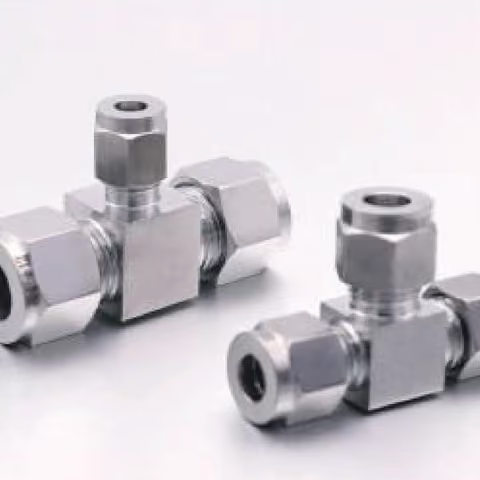
Stainless Steel Compression Reducing Tee — Sizes
Compression Reducing Tee: stainless steel compression fittings with smaller branch take-off. FerruleX factory RFQ. Stocked sizes ship fast. Fast stock shipping.
- Brand
- FerruleX
- Material
- SS316 / SS316L / SS304
- Size range
- OD 3–25 mm / 1/8"–1"
- Type
- Reducing compression tee
- Pressure
- 1000 psi standard / 4500 psi high-pressure
- Stock5–7 days after confirmation
- Make to order15–25 days production
- Payment / termsT/T ~30% or L/C · FOB Shanghai / Ningbo
- OEMLogo and drawings accepted · price on RFQ
Description
On a reducing tee the run keeps its full bore and the branch steps down to the smaller tube, so a 25 mm run can feed a 3 mm gauge leg through one body instead of a welded outlet. Bodies are SS316, SS316L or SS304, with ferrule ends on all three ports; tube OD covers 3 mm to 25 mm and 1/8 in to 1 in (3.175 mm to 25.4 mm). Standard bodies are rated around 1000 PSI, with a high-pressure variant to about 4500 PSI. Service is liquid or gas, on bright or hard tube. Give us the run OD, branch OD and pressure class; the two sizes are marked separately on the body.
Three ports, one of them smaller. The branch leg takes the fine tube for gauges and sampling points, the run stays at full bore, and nothing is welded into the header. Sizes span 3 mm to 25 mm tube OD and 1/8 in to 1 in, in 316, 316L or 304.
- Reduction
- The branch port steps down while the run bore stays unchanged.
- Ports
- All three ends take a ferrule tube connection.
- Pressure
- Around 1000 PSI standard; about 4500 PSI in the high-pressure variant.
- Tube
- Bright or hard stainless tube, 3 mm to 25 mm outside diameter.
Specifications
| Specification | Value |
|---|---|
| Brand | FerruleX |
| Material | SS316 / SS316L / SS304 |
| Size range | OD 3–25 mm / 1/8"–1" |
| Type | Reducing compression tee |
| Pressure | 1000 psi standard / 4500 psi high-pressure |
Request Quote
Prices stay on the RFQ. Send size, material, quantity and destination — the factory replies with price, lead time and packing. Packing, payment and the usual quote questions are on thedelivery pageand the FAQ.
Questions about this part
How should the tube be prepared before it enters the port?
Cut square with a tube cutter, then deburr both the outside edge and the bore. A burr or a slanted cut holds the ferrule off its seat and the joint will weep no matter how hard the nut is turned.
How deep does the tube go into the branch port?
Push it in until it stops against the shoulder inside the body, then hold it there while the nut is run down by hand. Insertion short of the shoulder leaves too little tube for the ferrule to bite.
How do I know the nut is tight enough?
Follow the turns specified for the tube size rather than judging by torque feel. The nut is brought finger tight, then turned further by the set amount; going past it work hardens the ferrule and cracks the tube.
Can a joint be remade after the nut has been loosened?
Yes, but only a limited number of times. The old ferrule stays on the tube and the nut is retightened to the same position; each remake deforms the ferrule further, so fit a new ferrule once the bite looks worn.
Does the branch leg need extra tube support?
Support the small tube close to the tee, because a gauge leg has little stiffness of its own. Without a clamp the branch takes vibration as a lever and the ferrule joint at that port loosens first.
What sets the pressure limit at the branch?
The smallest port governs the body, and the tube wall must carry the same pressure at the working temperature. A thin-wall branch tube lowers the usable rating below the body figure, whichever class you order.
Related products
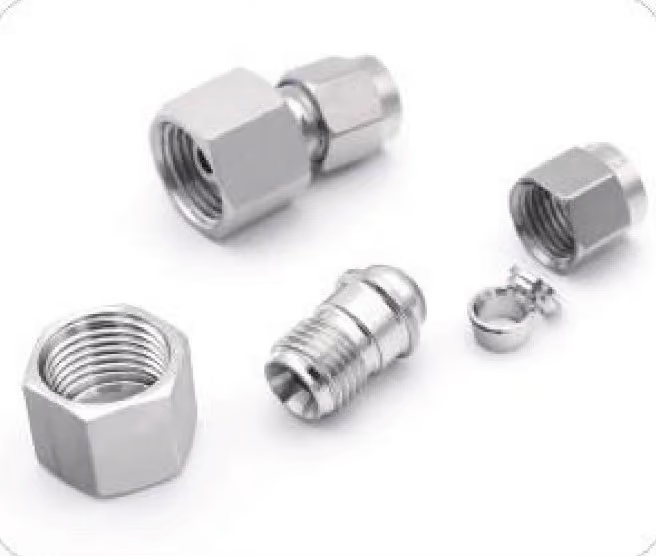
Stainless Steel Cylinder Connector — Sizes & Specs
Cylinder Connector: compact stainless instrumentation fitting for cylinder and specialty ports. SS316/304. FerruleX RFQ. Stocked sizes ship fast.
View details →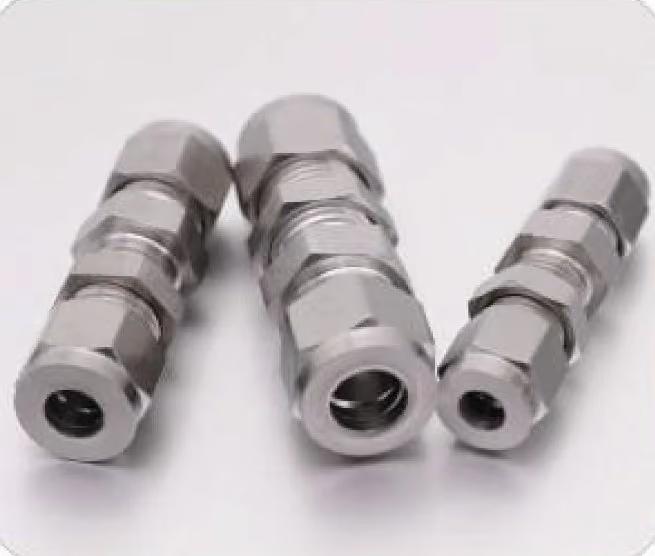
Stainless Steel Compression Bulkhead Union — Sizes
Compression Bulkhead Union: panel-pass stainless steel compression fittings, double ferrule. SS316/304. FerruleX RFQ. Stocked sizes ship fast. OEM RFQ welcome.
View details →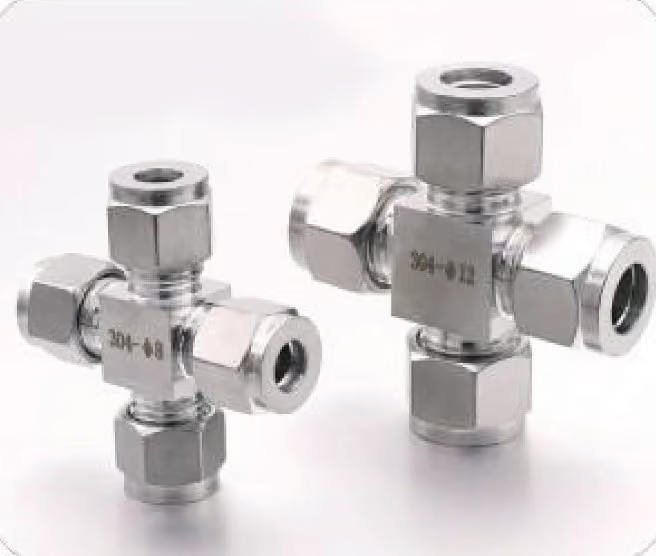
Compression Cross Fitting
Compression Cross Fitting: four-port stainless steel compression fittings for intersecting lines. FerruleX RFQ. Stocked sizes ship fast. Fast stock shipping.
View details →
Ground Finish Tube to Male Connector
Ground Finish Tube to Male Connector: refined stainless steel compression fittings, tube to male. FerruleX RFQ. Stocked sizes ship fast. Fast stock shipping.
View details →