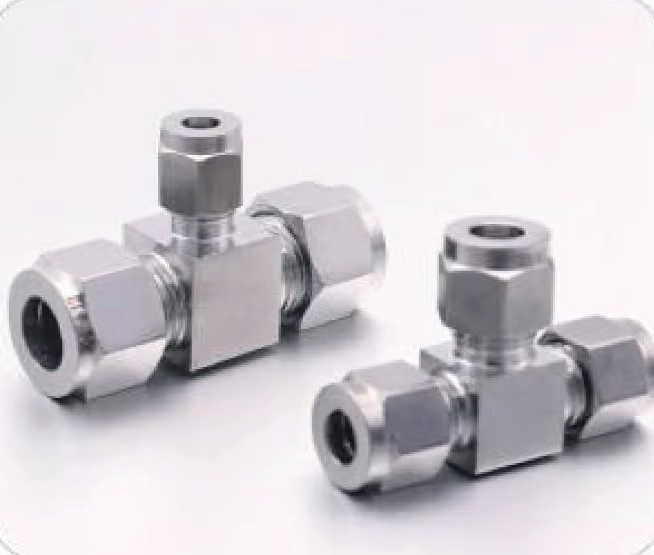
Compression fitting sizes are named after the tube’s outside diameter, never the inside. The ferrule bites that outside surface, and the size stamped on the body is the OD the fitting accepts.
Order by the tube OD. A fitting sold as 3/16 takes 3/16 in OD tube; a fitting sold as 12L takes 12 mm OD tube. If the drawing gives only an ID, or a plumbing-copper nominal, convert to the measured outside diameter before you open the catalogue.
When a drawing says just “3/16” and nobody asks of what, the wrong catalogue row ships and the fittings take a round trip.
Key takeaways
- Compression fittings size by tube OD, full stop. DIN 2353 names the size after it: 12L means 12 mm OD, light series.
- 3/16 inch is a real tube OD — the catalogues call it dash-3 — but a bare “3/16” on a drawing may come from plumbing-copper nominal sizing, where the ID-era convention hides an OD 1/8 inch larger.
- Tube is ordered as OD × wall; pipe is ordered as nominal size plus schedule. The two grammars do not translate by intuition — 1/2 NPS pipe actually measures 0.840 in OD.
- Same OD, different wall means different ID and different pressure rating — and wall thickness has to suit the fitting or the ferrule cannot grip.
- Five checks before ordering — OD or ID? wall? grade? ends? unit count — kill the classic mistakes.
Which number do I need to order?
The ferrule seals by biting the tube’s outer surface, so the whole joint follows the outer surface. Nothing in the joint touches the ID, which is why no ID appears anywhere in the sizing system.
The size stamped on the body is the tube OD it accepts — 6 mm, 1/4 in, 12 mm. DIN 2353, the bite-type benchmark, names each size by OD and series: 12L is 12 mm OD in the light series, 12S the same OD in heavy.
Fractional catalogues run the same logic from 1/16 in up, on the sequence 1/16, 1/8, 3/16, 1/4, 5/16. The mixed-standard detail is in metric versus fractional tube sizes.
Why does a bare 3/16 cause the wrong parts?
Three-sixteenths is where the rule earns its keep, because the number lives in two worlds. In the fitting catalogue, 3/16 in is a standard tube OD, listed as dash-3 in the common shorthand.
In plumbing copper it more likely came from the ID-era nominal convention of ASTM B88 tube, where the named size is not any actual dimension: a 1/2 nominal copper tube measures 5/8 in OD.
So a technician measures a copper line, reads 3/16 off the print, and orders a fitting that fits nothing on the bench. Same number, two worlds, one returned shipment.
| Number on the drawing | Sizing world | What the number names | What decides |
|---|---|---|---|
| 3/16 in, called dash-3 | Fitting catalogue | A standard fractional tube OD | Measure the outside and match the catalogue row |
| “3/16” on a copper line | ASTM B88 plumbing-copper nominal | A name that matches no actual dimension | Convert to the measured OD first — 1/2 nominal copper measures 5/8 in OD |
| 1/2 NPS, schedule 40 | Pipe table | A nominal name, not a measurement | Quote NPS plus schedule, never OD |
The trap has a cousin: same OD, different wall, different ID. ID equals OD minus twice the wall.
A 1/2 in OD tube at 0.049 wall has a 0.402 in bore; the same tube at 0.065 wall has 0.370. OD is what the fitting grips; wall decides whether it grips at all.
What a wrong order looks like at the bench:
| Symptom | Most likely cause | What to change |
|---|---|---|
| Fitting will not start over the tube | Number taken from a copper nominal, not a measured OD | Measure the outside and re-order by OD |
| Fitting slides on but the ferrule will not bite | Wall too thick for the range published for that size | Check the maker’s wall range for the size |
| Tube collapses as the ferrule closes | Wall too thin for the size | Move to a thicker wall, or to a size whose range fits |
| Right OD, wrong pressure class | OD quoted without wall or grade | Add wall thickness and grade — 316, 316L, 304 |
| Pipe number sent for a tube fitting | Nominal size read as an OD; 1/2 NPS measures 0.840 in OD | Quote OD × wall for tube |
| Two near-identical parts swapped | Units not stated on the line | State 6 mm versus 1/4 in explicitly |
Does wall thickness change the fitting?
The ferrule must bite the tube wall hard enough to seal, and the wall must survive the bite. Makers publish a wall range for each size.
Too thin and the ferrule collapses the tube instead of gripping. Too thick and it cannot close properly. Neither is a fitting defect — both are a mismatch between the tube and the range stated for that size.
Wall also sets the pressure rating, so OD alone never describes the part. Quote OD plus wall, and add the grade: 316, 316L and 304 change the pressure rating and compatibilities at identical dimensions.
What is the difference between tube and pipe ordering?
Tube and pipe are specified in two grammars, and mixing them is the second classic mistake. Tube is ordered as OD × wall — 1/4 in × 0.035, 6 mm × 1 — the dimensions you actually receive.
Pipe is ordered as nominal size plus schedule: 1/2 NPS, schedule 40. NPS is a name, not a measurement. A 1/2 NPS pipe measures 0.840 in OD whether the wall is schedule 40 (0.109) or schedule 80 (0.147).
The schedule encodes the wall, not the bore. The full grammar is in pipe schedule numbers explained and pipe vs tube: what is the difference.
| Tube | Pipe | Decisive for the order | |
|---|---|---|---|
| How it is quoted | OD × wall | Nominal size + schedule | Whether the number could be taped on the outside of the part |
| Example | 1/4 in × 0.035, 6 mm × 1 | 1/2 NPS, schedule 40 | The units you measured in |
| What the number names | The actual OD | A name, not a measurement — 1/2 NPS measures 0.840 in OD | Whether the figure came from a pipe table |
| Where the wall sits | Written out in the order | Encoded by the schedule: 40 = 0.109, 80 = 0.147 | The schedule, not the bore |
One rule: if the number could be taped on the outside of the part, quote OD; if it came from a pipe table, quote NPS and schedule.
What do I check before the RFQ goes out?
Five checks, in order.
- Step 1: OD or ID? Find which dimension the drawing’s number refers to. If it is a copper plumbing size, convert to the actual OD before opening the catalogue — calipers on the tube settle it.
- Step 2: Wall thickness? Record it with the OD, then check it against the fitting maker’s wall range for that size. Too thin and the ferrule collapses the tube; too thick and it cannot bite.
- Step 3: Material grade? 316, 316L, 304 — the grade changes pressure rating and compatibilities even at identical dimensions.
- Step 4: End forms? Compression end on one side, thread on the other — write each end separately, in the dash numbers field guide shorthand if your plant uses it.
- Step 5: Unit and count? Confirm the units and the piece count. A 6 mm and a 1/4 in fitting are close enough to argue about, different enough to leak.
Then write the line list:
tube OD— the outside diameter, in the units measured: 3/16 in, 6 mm, 12 mm.wall thickness— with the OD, every time; both decide the pressure rating.material grade— 316/316L/304, seamless or welded as applicable.end forms— one line per end: compression size, thread form and size, weld prep.quantity and spares— plus a note if remakes are expected, so ferrules arrive with the fittings.- One line list, one quote: our compression fittings range is sized by OD with the wall range stated per size.
FAQ
Is a 3/16 compression fitting for 3/16 OD or ID?
3/16 OD. Every compression fitting size is the tube’s outside diameter, and catalogues list 3/16 in as a standard fractional OD, dash-3. Plumbing copper uses ID-era nominals, so measure the outside before ordering.
How do I measure tube OD in the field?
Close calipers on the tube and read the OD directly. With no calipers, wrap a tape round the tube, measure one circumference and divide by π. Threaded ends are covered in how to measure NPT fittings.
Why does wall thickness matter to a compression fitting?
The ferrule must bite the wall hard enough to seal, and the wall must survive the bite. Makers publish a wall range per size: thinner collapses the tube, thicker cannot close. Wall also sets the pressure rating.
Is pipe size the same as tube size?
No. Tube is named by actual OD and wall, so what you measure is what you get. Pipe is named by nominal size and schedule, a name that stopped matching any real dimension: 1/2 NPS pipe measures 0.840 in OD.
What do the DIN numbers like 12L mean?
DIN 2353 sizes are the tube OD in millimetres plus a series letter. 12L is 12 mm OD in the light series; 12S the same OD in heavy, with thicker wall and a higher pressure class.