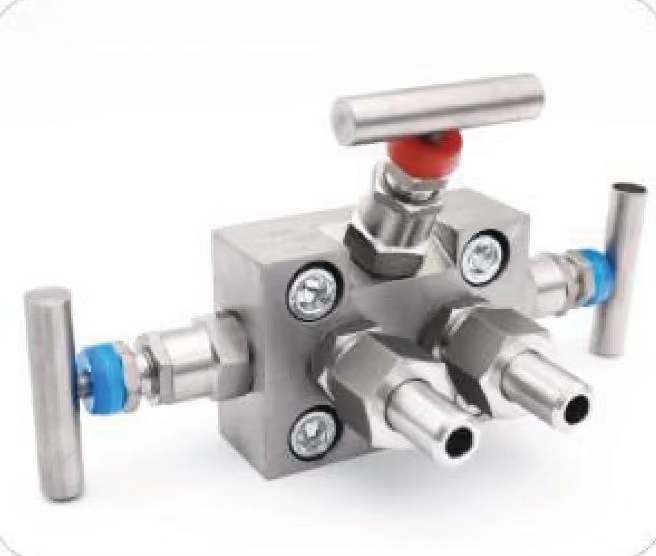
Instrument manifolds are the small steel block between your process and your instrument, and they deserve their own line on the RFQ. The valve count answers the question: two valves isolate and vent a gauge, three add the equalizer a differential transmitter needs, five add test ports so you can calibrate without a shutdown.
Pick by what the instrument must do in service, and the style follows. Pick wrong and you either cannot zero the transmitter without a shutdown, or you paid for five valves to do a two-valve job.
The one-piece-body logic that shrinks leak paths here is the same idea a discrete needle valve uses at the single-point level in how a needle valve works — the manifold is that idea, multiplied and bolted together.
Key takeaways
- Valve count maps to function: 2-valve = gauge isolation plus vent; 3-valve = differential transmitter isolation plus equalizing; 5-valve = all of that plus vent ports for calibration without shutdown — one family covering the whole valve manifold range.
- The equalizing valve is the safety device of a 3-valve manifold: it protects the differential cell from one-sided overpressure during operation.
- Operating sequence matters more than the block: close one block, open the equalizer, then close the other — never trap the cell single-sided.
- Manifolds replace threaded valve assemblies: one forged body means far fewer leak paths and faster hook-up.
- Direct-mount transmitter manifolds bolt to the IEC 61518 flange; remote-mount gauge manifolds use threaded ports, typically 1/2 NPT.
Which one do I need?
Read the instrument before the catalogue. Two things decide the block: how many process ports the instrument has, and whether it can be taken out of service for calibration.
| Style | Valves in the block | Instrument it serves | What actually decides it |
|---|---|---|---|
| 2-valve | One block valve plus one vent (bleed) | Pressure gauge, pressure switch, gauge-pressure transmitter | One process port — nothing to equalize |
| 3-valve | Two block valves plus a centre equalizer | Differential pressure transmitter | Two process ports and a cell that must never see one side alone |
| 5-valve | 3-valve layout plus two vent/test valves | DP transmitter in a loop that must keep running | Calibration has to happen without a shutdown |
| Gauge root valve | One isolation valve at the process tap | The whole instrument string above it | A primary isolation point is needed below the manifold |
Mounting follows the instrument, not the valve count. Direct-mount transmitter manifolds bolt to the IEC 61518 flange; remote-mount gauge manifolds use threaded ports, typically 1/2 NPT.
Four lines close the specification before you quote:
manifold style— 2-, 3- or 5-valve, or a single gauge root valve.mounting— direct-mount to the IEC 61518 flange, or remote threaded, typically 1/2 NPT process and instrument ports.valve type inside— needle or ball; the needle valves category covers the trims.pressure class and material— with certificate type where the project requires it.
What does a 2-valve block do that a gauge root valve does not?
The 2-valve manifold is one block valve plus one vent (bleed) valve, made for static pressure instruments: a pressure gauge, a pressure switch, a gauge-pressure transmitter.
The block valve isolates the instrument from the process. The vent bleeds trapped pressure to atmosphere so the gauge can be removed or calibrated. That is the whole job, and for a simple gauge it is all the job you need.
Mounting is direct — the block bolts to the instrument or tees into the line — and it is the cheapest way to give a gauge a serviceable isolation point. The 2-valve manifold line covers the direct-mount pattern.
Below the manifold, at the process tap itself, sits the gauge root valve: the primary isolation point between the line and everything above it — manifold, snubber, gauge.
Root valves are most often built as rising-stem metal-seated needle valves, straight or angle pattern, in the high-pressure classes. They let the whole instrument string be serviced without depressurising the process. Our gauge root valve is the single-valve version of that isolation logic for simple gauge installations.
When does a differential transmitter need three valves?
A differential pressure transmitter has two process ports — high and low — and a measurement cell that compares them. The 3-valve manifold gives each port its own block valve and adds a centre equalizing valve between them.
The equalizer is not a convenience. It is what lets you zero the transmitter, and it is what saves the cell during commissioning. The rule that matters: never let the cell see pressure on only one side.
References differ on the exact close-first order, high side first or low side first, and both are defensible. The invariant is that the equalizer is open while the second block closes, so the cell never fights a one-sided differential.
The valve family inside is needle or ball. The needle-versus-globe selection logic from how a needle valve works applies at manifold scale. See the 3-valve manifold product line.
How do you zero a 3-valve manifold and put it back in service?
Two sequences, mirrored. The zero-check first:
- Close one block valve.
- Open the equalizing valve; the reading decays to zero.
- Close the equalizing valve.
- Reopen the block valve.
Bringing the manifold back into service:
- Open the equalizing valve first.
- Crack open one block valve slowly.
- Close the equalizing valve.
- Open the second block valve.
Whichever side you start on, the invariant holds: the equalizer is open while the second block closes. Skip that and the cell takes a one-sided differential.
When is a 5-valve block worth it?
The 5-valve manifold takes the 3-valve layout and adds two vent/test valves, one on each side of the equalizer. Those test ports are the payoff.
With both block valves closed, the equalizer open and a test port opened, you can connect a calibration hand pump or reference instrument to the transmitter. Verify, trim or calibrate while the process keeps running, then return to service without breaking a single process connection.
For loops where a shutdown costs production, that is the entire reason the block exists. The 5-valve manifold line is built around this calibration-duty pattern.
One sequence warning from the instrumentation references: when equalizing a 5-valve manifold, open the equalizer on the live side deliberately. Opening the wrong side first can over-pressure the transmitter, which is the opposite of protection.
What goes wrong, and what do you change?
Most manifold faults are selection or sequence errors, not valve failures. The symptom usually names the cause.
| Symptom | Most likely cause | What to change |
|---|---|---|
| Transmitter reads zero in service | Equalizing valve left open | Close the equalizer; the measurement only reads true with it shut |
| Reading wrong after a block was operated | Cell saw one-sided pressure during the sequence | Equalizer open while the second block closes |
| Cannot zero without stopping the process | 3-valve block on a loop that must keep running | Move to a 5-valve block with test ports |
| Gauge cannot be removed for calibration | No vent downstream of the isolation valve | 2-valve block with a vent, or a gauge root valve as primary isolation |
| Leak at the valve stack | Threaded assembly of discrete valves, a joint at every connection | One forged manifold body with internal passages |
| Half the ports connect to nothing | 3-valve block on a single-port instrument | 2-valve block or gauge root valve; less dead volume |
| Transmitter will not bolt up | Threaded instrument port where a flange is required | Direct-mount block on the IEC 61518 flange |
FAQ
Can I use a 3-valve manifold on a gauge?
Yes, if the gauge is differential — remote-mount 3-valve blocks are catalogued for differential pressure gauges. On a single-port gauge half the ports connect to nothing. A 2-valve block or gauge root valve does the same job in less space.
Why does manifold valve count matter?
Each valve is a function: two isolate and vent, three add the equalizer that protects the cell, five add test ports for calibration without a shutdown. The count tells you what maintenance the loop can survive.
What is the equalizing valve for on a 3-valve manifold?
It links the high and low sides of a differential transmitter. During zeroing it balances the cell so the instrument reads true zero; in service it stays closed or the measurement collapses. It also guards the cell against one-sided pressure.
Do manifolds really reduce leaks?
Structurally, yes. A threaded assembly of discrete valves has a joint at every connection; a manifold replaces the stack with one forged body and internal passages. Fewer connections means fewer leak paths and faster hook-up.
What connections do I specify on a manifold RFQ?
Specify process and instrument ports by thread and size; 1/2 NPT is the common remote-mount pattern. Direct-mount transmitter blocks use the IEC 61518 flange instead. Add vent/test port size, pressure class, body material and internal valve type.
Related: for air-supply distribution blocks rather than instrument manifolds, see stainless pneumatic manifolds.