Stainless pneumatic manifolds are where a panel becomes a system: filtered, regulated air, distributed from one block to a bank of valves, throttles and cylinders, in a material the environment cannot eat.
Stainless where washdown, chemical splash or marine air reaches the part; aluminum in a dry cabinet. The chain is filter → regulator → valve → speed control → cylinder, with one block feeding the bank. Standard plant air puts the whole assembly in the 10-bar class.
Key takeaways
- Stainless earns its cost where washdown, corrosion or hygiene rule: food and beverage, pharma, marine and offshore, chemical plants.
- The FRL train has three jobs: the filter strips water and particles, the regulator sets stable working pressure, the lubricator adds oil mist — and modern lubricated-for-life components increasingly leave the lubricator out.
- A manifold distributes one supply to many consumers: shorter runs, fewer fittings, fewer leak points, cleaner troubleshooting.
- The component chain runs filter → regulator → valve → speed control at the cylinder port → cylinder, and each link earns its own line on the RFQ.
- Pneumatic manifolds are typically 10-bar-class parts; stainless FRL units exist as complete washdown-rated sets.
Which one do I need: stainless or aluminum?
The environment decides, not the part count. Standard aluminum pneumatics fail by corrosion, and the trigger conditions are specific: repeated moisture and caustic washdown, marine and coastal air, chemical splash and vapor, and hygiene-regulated production where the material itself is part of the compliance story.
| Material route | Where the plant runs it | Failure mode outside that duty | What decides it |
|---|---|---|---|
| Aluminum air prep and manifold | Dry cabinet, clean air, no washdown | Corrosion between the block and the first valve | Whether washdown, chemical splash or marine air reaches the part |
| 304 stainless filter, regulator or FR set | Food and beverage, pharma, marine and offshore, chemical | Cost, with no corrosion penalty in that duty | Whether hygiene or corrosion governs the whole assembly |
| 316 stainless, food-duty FDA-compliant variants | The same duties, where a higher grade is called out | Cost | Which grade the plant specification names |
Stainless air-prep families — filters, regulators, combined FR units — come in 304 and 316, with food-duty FDA-compliant variants in the range; they are marketed explicitly for these environments. Outside them stainless is money spent on protection you do not need: the aluminum version is cheaper, and a dry enclosure runs it for decades.
Decide at system level, not part by part. A stainless block feeding standard-steel valves buys the corrosion resistance back at the weakest link. A dry enclosure a room away can stay aluminum, but mixing materials inside one wetted assembly just moves the corrosion to the weakest part.
What does the FRL train actually do?
Three jobs, one letter each. The filter strips liquid water and solid debris before either reaches a valve seat or cylinder seal. The regulator sets a stable working pressure independent of supply fluctuation — the force side of every downstream cylinder calculation.
The lubricator injects a controlled oil mist for components that need it, and this is where practice has moved. Most modern valves and cylinders are lubricated for life, so the lubricator is fitted only when a downstream device calls for it. A large share of machine-air applications run filter-regulator only.
Spec the FR pair as the default and add the L only on evidence. Fitting a lubricator by default is a documented specification error. Add it for legacy tools or air motors that call for oil mist; keep it out of instrumentation and food-adjacent air, where oil mist is contamination rather than service.
Manifolds and their air prep are typically 10-bar-class parts. Maker ratings commonly run 0–10 bar with some margin, and general-industry practice puts working pressure in the 80–150 psi band. Heavy-duty blocks go higher, but for standard plant air the 10-bar assumption is safe — and the chain is rated at its weakest link, not at the block.
Manifold, or individual tube runs?
From the air-prep outlet the supply fans out, and the manifold is how it fans without becoming spaghetti. A distribution block channels one supply into multiple outlet ports and eliminates the parallel runs of individual tubing: shorter lines, fewer fittings, fewer leak points, a cleaner layout.
| Route | What you get | Where it hurts | What decides it |
|---|---|---|---|
| Individual tube runs | Point-to-point runs, no block to mount | A web of tubing that is hard to route and to troubleshoot, and generous with leak points | How many consumers the supply feeds |
| Distribution manifold | One supply into multiple outlets, short runs, fewer fittings | Spare ports have to be planned, not added later | Whether a leg will need isolating, or the machine will grow |
When a leg misbehaves the block localizes it instead of making you trace a web, and when the machine grows the block has spare ports. Maker literature counts reduced tubing clutter and simplified troubleshooting among the manifold’s main wins.
Sizing the block is port arithmetic. The common push-in outlets run 4, 6, 8 and 10 mm, with G threads on the supply, and the 10-bar class covers typical plant air. For the panel hardware around the block, quick-screw fittings cover the pneumatic-class connections. The instrument-side sibling of this architecture is instrument manifolds explained.
What is the component chain?
Air passes the links in this order, and each one earns its own line on the RFQ.
- Step 1 — Filter. The barrier: rating from the dirtiest air the plant makes, per inline filters for instrument lines.
- Step 2 — Regulator. Sets pressure; size by flow at the bank, not by one valve.
- Step 3 — Valve. The brain; stainless bodies where the washdown reaches.
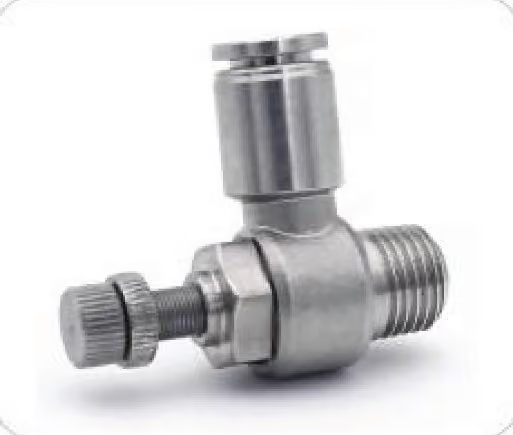
- Step 4 — Speed control. Mounted at the cylinder port, meter-out by default: air throttle valves.
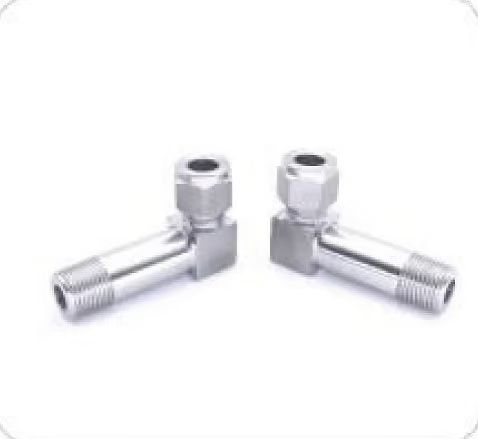
- Step 5 — Cylinder connector. Port thread from the datasheet, family from the motion: cylinder connectors.
- Step 6 — Silencer. The exhaust treated before it becomes noise: pneumatic silencers.
What goes wrong, and what do I change?
Nearly every failure on this assembly traces back to a link specified against the wrong thing.
| Symptom | Most likely cause | What to change |
|---|---|---|
| Corrosion where the block meets the first valve | Stainless block feeding standard-steel valves | Carry stainless through the wetted chain, not part by part |
| Water or debris on a valve seat or cylinder seal | Filter rated for average air, not the dirtiest the plant makes | Rate the filter from the dirtiest air |
| Pressure sags when the whole bank strokes | Regulator sized by one valve instead of by the bank | Size the regulator by flow at the bank |
| Cylinder runs fast or slams at the end of stroke | Speed control not meter-out, or not at the cylinder port | Move to meter-out throttle at the cylinder port |
| Oil film in instrumentation or food-adjacent air | Lubricator fitted by default | Run filter-regulator only and add the L on evidence |
| Leak or clogged leg hard to trace | Individual tube runs built as a web | Consolidate on a distribution block with spare ports |
| Exhaust noise at the valve | No silencer on the exhaust | Treat the exhaust with a silencer |
The pattern is the same in every row: the weakest link sets the verdict for the whole bank, so each link is rated on the same duty and the same air.
What goes on the RFQ?
A circuit that arrives as one list prices as one assembly. Write it in the order the air travels.
environment— washdown, food, marine, chemical: the words that select stainless throughout.FRL set— filter grade, regulated pressure, lubricator yes or no.manifold— supply thread, outlet count and sizes, material.valve— model family and body material.speed control— throttle direction, meter-out by default, at the cylinder port.cylinder connector— port thread from the datasheet, family from the motion.silencers— listed with the chain, not added after.- One list, one quote: the whole bank prices together, and the quote comes back matching the drawing instead of matching a guess.
FAQ
Is stainless FRL worth it for food plant air?
Yes, where washdown reaches it. Aluminum air prep corrodes under repeated caustic washdown; stainless filter-regulator sets with food-compliant variants are built for that duty. A dry enclosure a room away can stay aluminum.
Do I still need a lubricator in the FRL?
Only if a downstream device calls for it. Modern valves and cylinders are lubricated for life, so filter-regulator is the default; fitting a lubricator by default is a specification error.
Why a manifold instead of individual tube runs?
A block gives one supply many outlets with short runs and few fittings, where individual runs build a tubing web with generous leak points. It also localizes a misbehaving leg and keeps spare ports for growth.
What pressure class is a pneumatic manifold?
Typically the 10-bar class: maker ratings commonly run 0–10 bar with margin, and general practice puts working pressure in the 80–150 psi band. Heavy-duty blocks go higher.
How do I write one RFQ for the whole circuit?
List it in the order the air travels: FRL set with filter grade and regulated pressure, manifold with port sizes, valve family, throttle direction, cylinder port threads and silencers. Add the environment word that selects stainless.