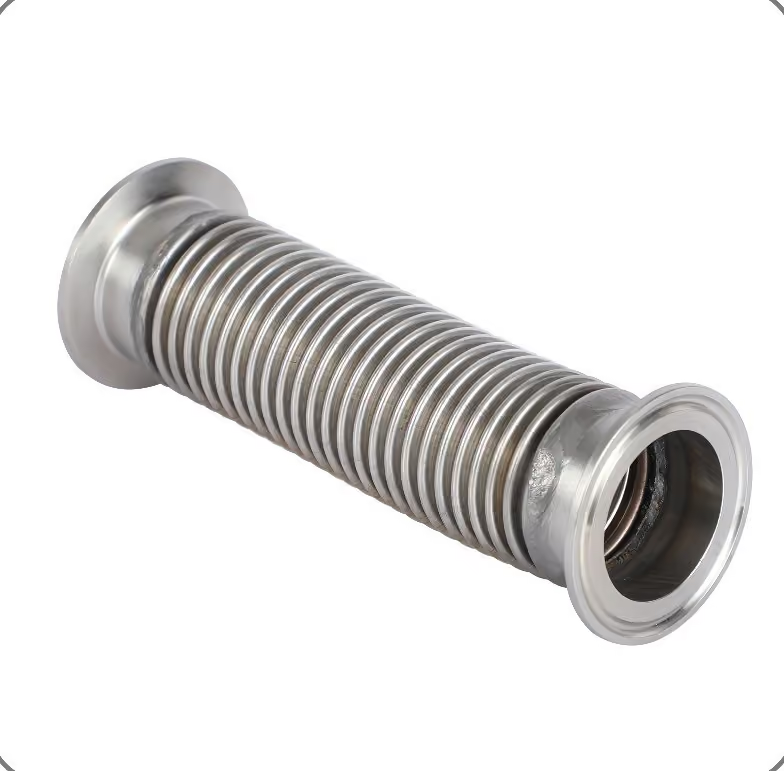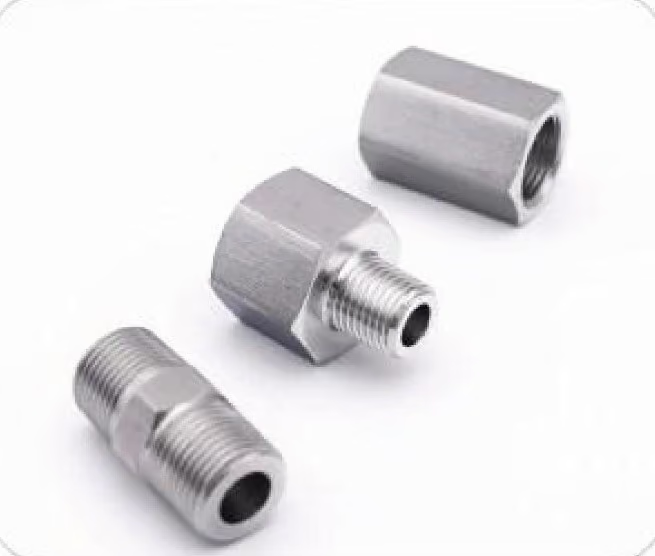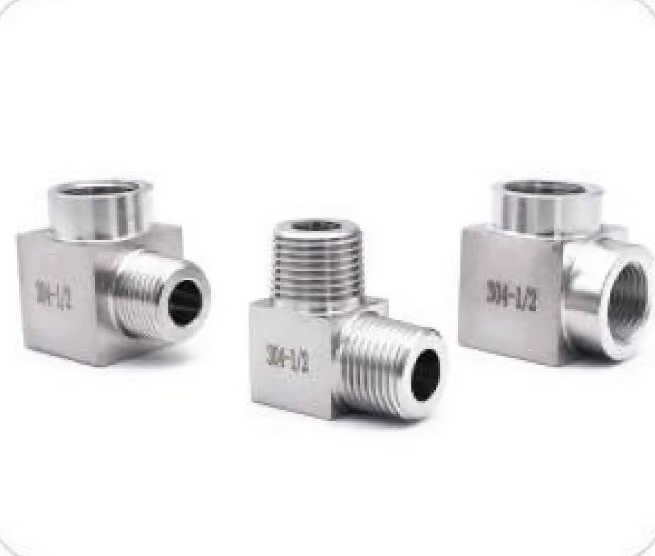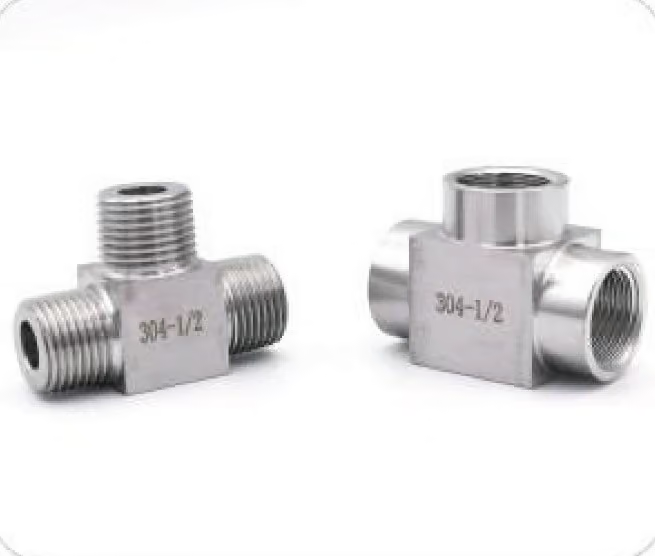
NPT seals on its own tapered thread, with sealant filling the remaining spiral leak path. G (BSPP) is parallel: the thread carries no seal, and a bonded washer or O-ring at the face does the work. No size of one substitutes for the other, so every threaded end has to be named before an RFQ is issued.
Key takeaways
- NPT (ASME B1.20.1) is a 60° thread tapered 1:16 — ¾ inch per foot — that seals on its own flanks using PTFE tape or liquid sealant; G/BSPP (ISO 228-1) is a 55° parallel thread that never seals on the thread and instead seals on a bonded washer or O-ring at the face.
- NPT and G are not interchangeable: some sizes share the same threads-per-inch, but the 60°-versus-55° flank mismatch galls the threads and the joint weeps at line pressure.
- Sealant belongs on tapered threads only — dope on a G thread can keep the fitting from reaching proper torque and leave the face seal under-compressed.
Which one do I need?
The mating port decides it, not the look of the thread. Match whatever standard the female side was cut to, and get the drawing to say so in writing.
| What you are looking at | Most likely standard | What actually decides it |
|---|---|---|
| North American panel, compressor or utility skid | NPT | the port is cut to ASME B1.20.1, and sealant is part of the joint |
| European, UK, Asia-Pacific or Middle East OEM equipment | G or R | whether the port is parallel (G, ISO 228-1) or tapered (R, ISO 7-1) |
| A drawing that says only “BSP” | ambiguous | ask which variant; G needs a face washer, R needs sealant |
| A part being replaced on an existing panel | whatever is marked | the marking or drawing — “NPT”, “G1/4”, “Rp”, “Rc”, “R” |
| Export skid with a metric compression body on one end | mixed | both ends named explicitly on the RFQ |
North American panels, compressors and utility skids run NPT almost exclusively. Europe, the UK, Australia, India, the Middle East and most Asian OEM equipment run G or R.
Metric instrumentation ports (M5–M24 style) are layered on top of both. Export skids we build routinely mix all three, which is normal provided the RFQ names each end.
How do the two seal?
A tapered thread is its own seal. As an NPT male screws into an NPT female, the 1:16 taper wedges the flanks together; sealant — PTFE tape or pipe compound — fills the remaining spiral leak path.
A parallel thread is only a fastener. G threads run in with clearance and spin home by hand, and the pressure-tight seal is made separately — by crushing a bonded seal, an O-ring in a recess, or a flat gasket against a machined face.
| NPT | G (BSPP) | |
|---|---|---|
| Governing standard | ASME B1.20.1 | ISO 228-1 (ex-BS 2779) |
| Thread form | 60° | 55° Whitworth |
| Taper | 1:16 (¾ in per ft) | none — parallel |
| Seals on | thread flanks + sealant | face: bonded washer / O-ring |
| Sealant needed | yes | no — it can spoil the face seal |
| Typical region | North America | Europe, Asia, export skids |
| What decides the pick | the port is NPT, and sealant is part of the joint | the port is G, and a face washer carries the seal |
Printable versions of both thread families live on our NPT thread chart and BSPP thread chart sheets.
How do I tell which thread I have?
Start with the marking, then confirm it on the bench. Similar TPI is the one piece of evidence that proves nothing on its own.
- Step 1 — read the marking. “NPT”, “G1/4”, “Rp”, “Rc” or “R” on the part or the drawing settles it outright.
- Step 2 — feel the make-up. A G male spun into a matching G female turns home with clearance; an NPT male starts easy and wedges within a few turns.
- Step 3 — run calipers along the thread. A male NPT’s diameter visibly shrinks toward the end; a G male’s does not.
- Step 4 — gauge the pitch. A pitch gauge confirms TPI, but similar TPI does not prove compatibility.
- Step 5 — check OD and TPI against a lookup table for the size in hand before you accept the part.
For the full bench routine — pitch gauge, calipers, and an OD + TPI lookup table for every common size — see how to identify NPT vs BSP threads.
Why do mixed threads leak?
The traps look compatible and are not. NPT into G: the taper wedges against parallel threads until something yields, but there is no designed seal path — the joint feels tight and weeps under pressure.
G into NPT is the reverse. The parallel thread never wedges, and the face has nowhere to land.
Even NPT into BSPT — both tapered at the same 1:16 — fails. The 60° American flank and the 55° Whitworth flank ride on crest contact instead of the faces, galling on assembly and leaking under temperature or vibration.
On stainless fittings the risk compounds: crest contact under assembly torque is exactly the condition that galls stainless threads. See why stainless steel threads gall and how to prevent it for the mechanism and the assembly-lubricant countermeasure.
Cross-threaded “but it went in” joints are the most common thread callback we see on imported panels.
| Symptom | Most likely cause | What to change |
|---|---|---|
| Joint feels tight but weeps at line pressure | NPT male run into a G female — the taper wedges against a parallel thread with no seal path | Change the port to the matching standard; more tape will not close it |
| G joint leaks although plenty of PTFE tape was used | tape kept the face from compressing the bonded washer | dry bonded seal or O-ring, clean and dry, no sealant on the thread |
| Threads gall or seize during make-up | 60° NPT flank riding on 55° BSPT crests; stainless work-hardens on crest contact | pair matching standards; assembly lubricant, then inspect for galling |
| Parallel male bottoms out with the face still loose | there is no sealing face for it to land on — G into NPT | fit an adapter machined for the two standards involved |
| Threads engage a few turns then jam | cross-threading, or mixed 60°/55° forms | stop; identify both ends before adding torque |
What about R / ZG (BSPT)?
British taper pipe thread — R for the male, Rc for the female, ZG on many Chinese drawings — follows ISO 7-1; older references cite BS 21 or EN 10226-1. It seals on the thread with sealant, like NPT.
A G male can legitimately assemble into an Rc female where the design intends a thread-and-face combination. R and NPT still do not mix. If a drawing says only “BSP”, ask which variant before it becomes a purchase order.
| NPT | G (BSPP) | R / ZG (BSPT) | |
|---|---|---|---|
| Thread form | 60° Unified, tapered | 55° Whitworth, parallel | 55° Whitworth, tapered |
| Standard | ASME B1.20.1 | ISO 228-1 | ISO 7-1 (older: BS 21, EN 10226-1) |
| Taper on diameter | 1:16 | none (parallel) | 1:16 |
| Seals on | Thread flanks (interference) plus sealant tape or paste; NPTF is a separate dryseal spec, not a no-sealant guarantee | End face — bonded sealing washer or O-ring; the threads themselves carry no seal | Thread flanks (interference) plus sealant |
| Typical pairing | NPT male into NPT female | G male into G female, washer under the face | R male into Rc female (R into Rp parallel female is also used) |
| Where you meet it | North American panels, compressors, utility skids | Europe, UK, Asia-Pacific, Middle East OEM equipment | Same G markets, wherever a drawing calls out taper |
| Mixing with either of the others | Engages a few turns at best; cannot be relied on to seal | Feels tight, weeps under pressure — no designed seal path | Engages a few turns, jams on crest contact |
| Spot-check at 1/2 in | 14 TPI, major ≈ 0.840 in (21.34 mm) | 14 TPI, major ≈ 20.955 mm | 14 TPI, major ≈ 20.955 mm |
| Spot-check at 1/4 in | 18 TPI, major ≈ 0.540 in (13.72 mm) | 19 TPI, major ≈ 13.157 mm | 19 TPI, major ≈ 13.157 mm |
The 1/2 in row is the trap that catches buyers: 14 TPI on both sides invites the conclusion that NPT and BSP interchange there. The flank angle and the major diameter still differ — the threads are not compatible at any size.
What do I send with the RFQ?
List both ends and the material grade, and the quote comes back without a clarification round.
- Tube OD or pipe size, and the thread standard on each end — e.g. “6 mm tube × 1/4 NPT male” or “G1/2 male × Rc1/2 female”
- Whether “BSP” on the drawing means G (parallel) or R (taper)
- Material grade (SS304 / SS316 / SS316L)
- Whether bonded seals or thread sealant should be included
- Marking on the part being replaced, for repeat orders
- Quantity and destination
Start from the compression-to-male-connector range for tube-to-thread bodies, or the female threaded ball valve and straight female needle valve lines for threaded valves. Then request a factory quote with both ends spelled out.
FAQ
Can I seal NPT with a gasket instead of tape? No. NPT has no sealing face: the seal is thread flank interference plus sealant. A gasket sits unloaded, and skipping sealant leaves the spiral leak path open.
Is G thread the same as BSP? Almost. BSPP, the parallel variant, is G under ISO 228-1. BSP also covers BSPT, the tapered R/Rc variant of ISO 7-1, which seals on the thread like NPT.
Why did my G-thread joint leak when I used plenty of PTFE tape? Because the seal is at the face, not the thread. Tape lubricates the assembly, so the fitting reaches a false torque before the washer compresses. Use a dry bonded seal or O-ring.
Are NPT and BSPT interchangeable if the TPI matches? No. The 1:16 tapers match numerically, but the 60° versus 55° flank angle makes the threads ride on their crests, gall and leak. Use a proper adapter rather than forcing the pair.
How do I convert between NPT and G on an existing panel? With a male-female adapter machined for exactly the two standards involved, such as our male-female straight adapters made to order. Adapters are cheap; cross-threaded valves and remade panels are not.