NPT vs NPS is the smallest possible difference in thread nomenclature — one letter — and it decides everything about how the joint seals.
NPT is cut on a taper and seals on the thread itself. NPS (National Pipe Straight) runs parallel and never seals on the thread, so the joint lives or dies on a gasket, O-ring, or sealing face.
The two series share the 60° thread form and the same nominal threads per inch at each size. That is exactly why a pair of them hand-tightens nicely and leaks immediately when confused.
Key takeaways
- Taper vs straight is the whole difference: NPT interference-wedges and seals on the thread flanks with sealant; NPS has no interference and requires a gasket, O-ring, or face seal.
- “NPS” is doing double duty in the industry — National Pipe Straight for threads, Nominal Pipe Size for pipe. Context (a thread callout vs “NPS 2, schedule 40”) tells you which is meant.
- Interchange is partial and asymmetric: an NPT male into an NPSC coupling is a standard combination, but an NPS male into an NPT female has no thread seal at all.
- The suffix letters are duty codes: NPSM (mechanical joints), NPSL (locknuts), NPSH (hose couplings), NPSI (intermediate-fit) — and NPTF is the dryseal taper, a different animal from both.
- On drawings and RFQs, write the series, size, standard, sealing method, and material — a bare “1/2 NPS” leaves the seal undefined and the part unorderable.
Which one do I need?
The choice is not about threads per inch or what is on the shelf. It is about where the seal is allowed to live — on the thread, or on a part designed for the job.
| If the joint must… | Specify | What decides it |
|---|---|---|
| Seal as supplied, with tape or compound | NPT | The 1:16 taper’s flank interference is the seal |
| Seal with a gasket, O-ring, washer, or face | NPS — NPSM for mechanical | A parallel thread develops no interference at any torque |
| Come apart and re-clock without renewing compound | NPS plus O-ring | The seal element, not the thread, holds the joint |
| Keep compound out of a high-purity line | NPS plus O-ring | No sealant sits in the leak path |
| Stop at a repeatable point | NPS to a shoulder or seat | The thread spins to a shoulder or nut seat and stops at a place the part fixes |
A taper is the only one of the two that can seal by itself. Where the thread carries the sealing duty — tape or compound filling the spiral leak path — the part is NPT.
Where compound is not acceptable, or the joint has to come apart and re-clock without renewing it, the straight series moves the sealing duty to an O-ring.
What actually differs?
NPT and NPS share the 60° Sellers form and, at each nominal size, the same threads per inch — 27 at 1/8, 14 at 1/2, 11.5 at 1. All per ASME B1.20.1, which governs the general-purpose inch pipe thread series, taper and straight together. A pitch gauge cannot separate them; a caliper can, twice.
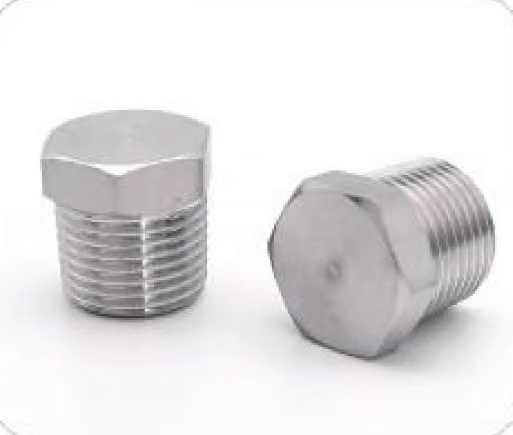
NPT is cut on a 1:16 taper on diameter, so the flanks of the male and female wedge into interference as the joint tightens. The thread is the seal, assisted by tape or compound filling the spiral leak path.
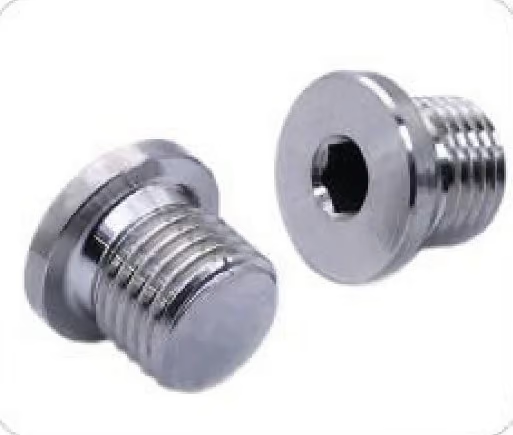
NPS is parallel: same diameter at every turn, no interference however far it winds in, and an open spiral for the leak path. Sealing duty moves entirely to a gasket, an O-ring in a groove, a bonded washer, or a machined face.
The difference shows at assembly. An NPT joint tightens to a position — roughly three wrench turns past hand-tight up to 2 in sizes, per the engagement allowances in B1.20.1.
An NPS joint spins freely to a shoulder or nut seat and stops at a place. The seal element, not the thread, decides leak-tightness.
What mates with what?
| Combination | Verdict | What seals it |
|---|---|---|
| NPT male × NPT female | The standard pairing | Taper interference plus sealant |
| NPT male × NPSC female coupling | A standard combination | The NPSC straight coupling taps the taper for its seal |
| NPS male × NPS female | Fine mechanically | A gasket, O-ring, or face — by design |
| NPS male × NPT female | No thread seal at all | Nothing: parallel in a taper never develops interference |
| NPT male forced into NPSM female | Risky | Nothing; the taper can damage the straight thread, which wants a free fit |
The rule of thumb: taper seals against taper; straight never seals alone. Where a design needs a joint that seals without thread compound — high-purity lines, frequent teardown, exact clocking — the straight thread plus O-ring is not a compromise, it is the correct architecture.
How to tell which one is in your hand, with a caliper, is in how to measure NPT fittings — the same procedure reads NPS, one reading apart.
What goes wrong at assembly?
Nearly every failure traces to one assumption: that a parallel thread will seal if it is tight enough, or that a taper will seal in a port designed for something else.
| Symptom | Most likely cause | What to change |
|---|---|---|
| Hand-tightens, then leaks at first pressure | Straight thread in a taper port; no interference develops | Match the pair; if the port is straight, seal on its gasket or O-ring |
| Compound applied, still weeps | Parallel thread gives compound nothing to wedge against | Drop the sealant; seal on the bonded washer, O-ring, or face |
| Straight thread damaged after assembly | Taper forced into an NPSM mechanical port | Fit the straight part the port expects — NPSM is a free fit |
| NPT joint weeps despite sealant | Engagement short of the specified turns | Tighten toward the B1.20.1 allowance, about three turns past hand-tight |
| Mixed NPT/NPTF pair assumed to be dryseal | A mixed pair is not a certified dryseal joint | Specify lubricant or sealant, as makers commonly do on NPTF |
| Part cannot be quoted from the callout | “1/2 NPS” states no sealing method | Write series, size, standard, sealing method, material |
The last row is a commercial failure rather than a mechanical one, and it is the one that reaches the shop floor as a question instead of an order.
What do the letters after NPS mean?
The straight series carries duty suffixes, and they explain most of the callouts on valves, gauges, and hose stems.
| Suffix | Duty | What seals it |
|---|---|---|
| NPSM | Mechanical | A separate element: free-fitting straight thread for joints locked by a jam nut or swivel; the common port style on gauge and switch bodies |
| NPSL | Locknut | Deliberately loose, cut full-form for locknuts and bulkhead jamming rather than for sealing, with allowance to pass over the pipe’s tapered thread |
| NPSH | Hose | A gasket or hose washer at the seat; the series sits outside the current B1.20.1 main table |
| NPSI | Intermediate | An intermediate-fit class between free and locknut, seen in maker catalogs for coupling duties |
The near-miss letter is NPTF (ASME B1.20.3, dryseal): a tapered thread with controlled crest and root truncation, so the threads interfere at the crests and roots as well as the flanks.
It is engineered to seal with less reliance on compound, though makers still commonly recommend lubricant or sealant. It is NPT’s stricter cousin, not an NPS variant.
The engagement and sealant-placement rules for the tapered family are in pipe dope vs Teflon tape on compression fittings.
NPS on a pipe note is a size, not a thread
The same three letters also abbreviate Nominal Pipe Size, the pipe dimensioning system, and drawings use both senses. In a thread callout (1/2-14 NPSM, 3/4 NPS), NPS means the straight thread series.
In a pipe callout (NPS 2, schedule 40), it means nominal pipe size, governed by ASME B36.10M. There the name is famously not the measurement.
NPS 1/2 through 12 all measure larger than their names: NPS 2 is 2.375 in OD, NPS 4 is 4.500 in. From NPS 14 up the OD finally equals the name, and NPS 13 does not exist — the sequence jumps.
| NPS number | Outside diameter |
|---|---|
| NPS 2 | 2.375 in |
| NPS 4 | 4.500 in |
| NPS 14 | 14.000 in, OD equals name |
A useful disambiguation habit for RFQs: if the words after NPS are a TPI or a suffix letter, it is a thread; if they are a schedule or a wall, it is a pipe size.
How the schedule picks the wall while NPS fixes the OD is the subject of pipe schedule numbers explained.
How do I check the thread and write the callout?
- Step 1 — caliper twice. Measure the same thread in two places, about a quarter inch apart.
- Step 2 — read a difference. Different readings, larger toward the fitting body, mean the taper of NPT.
- Step 3 — read a match. Identical readings mean the parallel NPS.
- Step 4 — check the form. A 60° pitch gauge leaf seats on both series, so it confirms the angle and does not separate them.
- Step 5 — confirm before ordering. Taper if the thread must seal; straight if a gasket, O-ring, bonded washer, or face carries the seal.
The full bench procedure, with both caliper readings in order, is in how to measure NPT fittings.
With the series known, a complete connection callout states the rest:
series and size— NPT, NPSM, NPSL… at the nominal sizestandard— ASME B1.20.1 (B1.20.3 for NPTF)sealing method— thread sealant; O-ring; bonded washer; face gasketmaterial— 316/316L/304 as the line requires
For example: 1/2-14 NPSM port, O-ring sealed, 316L tells the shop everything a bare “1/2 NPS” leaves out.
FerruleX machines NPT ends across the threaded fittings and valve range, with each end named on the quote — send the callout as written and the ambiguity is gone before quoting starts.
For the cross-family identification problem — is that tapered thread NPT or its British counterpart — the bench procedure is in how to identify NPT vs BSP threads, with the full dimensional table on the printable NPT thread chart.
FAQ
Can I thread an NPT male into an NPS female fitting?
It will enter, which proves nothing. The straight thread never develops full flank interference, so the seal still comes from the port’s gasket or O-ring. Forcing a taper into an NPSM port risks damaging the straight thread.
Do NPS threads need sealant?
No — and sealant will not give them one. A parallel thread has no interference to wedge compound into, so the spiral leak path stays open at any torque. NPS joints seal on a gasket, O-ring, bonded washer, or face.
What does NPS mean on a drawing?
Read what follows the letters. 1/2-14 NPSM or 3/4 NPS is National Pipe Straight, the parallel series of ASME B1.20.1. NPS 2, schedule 40 is Nominal Pipe Size, the ASME B36.10M pipe system.
Is NPTF the same as NPT?
No. NPTF is the dryseal taper per ASME B1.20.3, with crest and root truncations controlled so threads interfere there too, not only on the flanks. The two tapers assemble together, but a mixed pair is not a certified dryseal joint.
How do I quickly tell an NPT from an NPS thread in the field?
Caliper the same thread in two places, about a quarter inch apart. Different readings — larger toward the fitting body — mean NPT; identical readings mean NPS. A 60° pitch gauge seats on both, so the caliper decides.