Pick a stainless steel check valve by its closing mechanism and you have picked 90% of its behaviour: how much pressure it needs to open, how fast it closes, whether it cares which way is up, and how much room it needs in the line.
The three families — spring/piston, swing and dual-plate — differ on exactly those axes. Spring/piston for small-bore instrument work in any position, swing for large-bore mains where head loss decides, dual-plate for a tight pump discharge that hammers.
Key takeaways
- A check valve opens only when upstream pressure beats its cracking pressure — commonly a fraction of a psi on gravity swing types, 0.5–5 psi across typical industrial designs, and higher on stiff spring loads — so the available pressure differential, not the catalog default, must drive selection.
- Swing checks flow with the lowest pressure drop but close slowly by gravity and can water-hammer; spring/piston and dual-plate designs close in milliseconds by spring force, killing slam at the cost of a little head loss.
- Orientation rules separate the families: swing checks need horizontal runs or vertical-up flow, while spring-loaded designs work in any position — and cracking pressure, orientation and class belong on the RFQ together.
Which one do I need?
Start with the duty, not the size. Where two types could serve, the decisive column is the one that cannot be changed on site: the pipe run, the differential, or the face-to-face room.
| Type | Use it when | Decisive factor | Do not use when |
|---|---|---|---|
| Spring / piston | Small-bore instrument line, any orientation, quiet duty | The differential must beat the spring set, typically 0.5–5 psi | A large-bore main where the lowest head loss decides |
| Swing | Large-bore water or utility main, slow reversals, tight head-loss budget | The disc needs gravity to fall closed: horizontal or vertical-up | Pump discharge with a fast reversal — it hammers |
| Dual-plate | Pump discharge, skid package, space- or weight-limited station | Face-to-face room shorter than a swing body needs | Media that attacks exposed springs |
Each row is a duty the other two handle badly. For the check-versus-isolation layout and the mounting rules in brief, the companion post check valve vs ball valve covers the pairing logic.
How does each type work, and where does it fail?
Spring / piston. A guided poppet or piston works against a spring in a short, compact body. Forward pressure lifts the poppet when it beats the spring preload — the cracking pressure — and the spring drives it back the instant flow decays, closing before reverse flow establishes.
The consequences: silent operation, any-orientation mounting, and a cracking pressure set by the spring itself. Typical industrial designs crack in the 0.5–5 psi band, with standard spring loads at the low end and heavy loads higher.
In small instrument sizes, cracking pressures are also expressed in fractions of a bar, roughly 0.1–0.5 bar for spring-loaded patterns. Because closure is fast and orientation-free, spring checks are the pattern for the small-bore territory: instrument air, sampling, dosing pump discharge, CIP circuits.
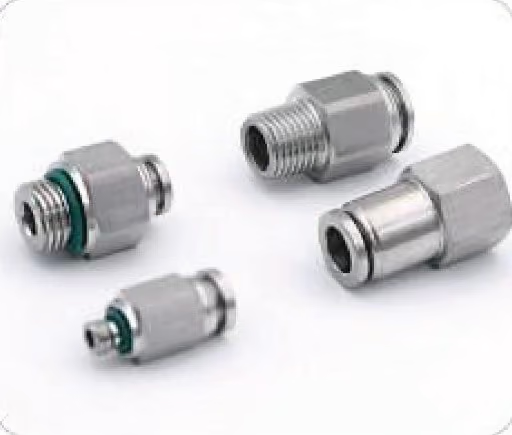
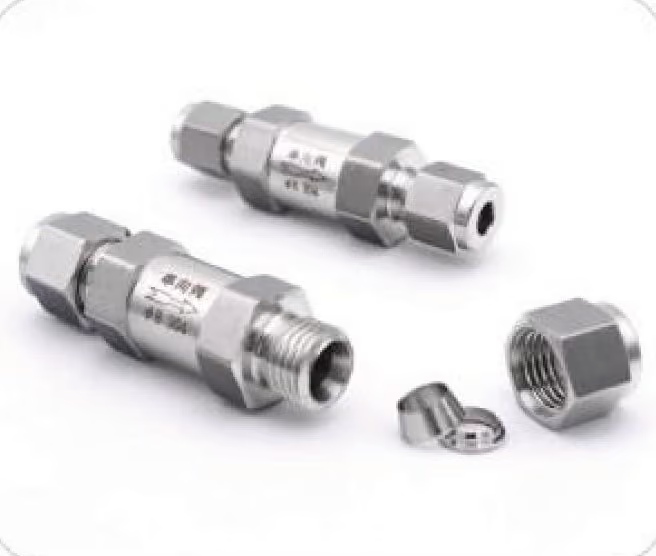
That is anywhere a compact valve has to close quietly, cycle after cycle. FerruleX’s stainless instrument range — compression check valves and threaded patterns — lives in this family.
Swing. A hinged disc swings fully open on forward flow, lying nearly parallel to the stream. That is the lowest pressure drop of any common check type, and the full-bore passage tolerates dirty and viscous fluids.
The same geometry is the weakness. Closure is by gravity alone, the disc has real mass and a long travel, and on a fast flow reversal — a tripping pump, a slamming valve — the disc arrives late and hammers.
Swing checks also demand respect for gravity: horizontal runs, or vertical pipes with upward flow, so the disc can fall closed. They suit large-bore, low-velocity water and utility mains where reversal is slow.
On pump discharge with quick reversals they are the classic source of water hammer. Stainless swing checks for process and utility lines are quoted per line size — see the swing check valve page.
Dual-plate. Take the swing concept, split the disc across its diameter, hinge the two half-plates on a central pin, and hold them shut with torsion springs. Each plate carries a fraction of a swing disc’s mass over a fraction of the travel.
So the springs close the valve in milliseconds — before reversal completes — in a thin wafer body that fits between flanges and weighs a fraction of an equivalent swing check. Pressure drop sits between swing and piston types.
The spring preload sets a modest cracking pressure, commonly in the same sub-psi to few-psi neighbourhood as other spring-assisted designs. Dual-plates suit space- and weight-limited stations: pump discharge manifolds, skid packages, flanged process lines.
That includes any line where a swing check’s face-to-face will not fit. FerruleX’s split-body check valves bring the same fast-closure idea to threaded instrument sizes; the flanged-line configuration is quoted per line size on the dual-plate check valve page.
What actually differs, side by side?
The table reads down a factor at a time. The last column is the one a supplier cannot decide for you.
| Factor | Spring / piston | Swing | Dual-plate | What settles it |
|---|---|---|---|---|
| Cracking pressure | ~0.5–5 psi typical; spring-set | Lowest — gravity-dependent | Low–moderate; torsion springs | The differential the line supplies |
| Closure speed | Fast (spring) | Slow (gravity) — can slam | Very fast (light plates) | How fast the reversal happens |
| Pressure drop | Highest of the three | Lowest | Low–moderate | The head-loss budget at the pump |
| Orientation | Any | Horizontal / vertical-up | Any | The pipe run on site |
| Envelope | Compact, threaded or tube ends | Long face-to-face, large bore | Thin wafer between flanges | Face-to-face room at the joint |
| Failure to fear | Spring fatigue, wrong cracking | Slam / water hammer | Springs in corrosive service | The media and the duty cycle |
Every row is a condition the supplier cannot change for you. State it, and the pattern choice makes itself.
What goes wrong in service?
Most of these are selection errors with a delayed bill, not wear. The symptom tells you which decision was wrong.
| Symptom | Most likely cause | What to change |
|---|---|---|
| Hammer on the discharge line at shutdown | Swing check: gravity closure arrives after reversal starts | Spring/piston or dual-plate, both close before reversal completes |
| Valve barely opens, chatters, erodes, fails early | Cracking pressure above the differential the line can supply | Ask for a cracking pressure the differential can afford |
| Check stays open, reverse flow passes | Swing check in vertical-down flow — the disc cannot fall closed | Re-mount horizontal or vertical-up, or take an any-orientation pattern |
| Closure degrades in aggressive media | Springs sit in the medium: dual-plate torsion springs, spring/piston loads | Change spring material and pattern to suit the media |
| Plate or hinge packs up in dirty duty | Hinge area exposed to viscous or solids-bearing media | Review the pattern; a full-bore swing passage tolerates dirty and viscous fluids |
Read the middle column as the decision and the third as the correction. None of these is a maintenance interval — each is a pattern or a cracking-pressure choice made before the valve was ordered.
What goes on the RFQ?
Cracking pressure, orientation and class belong on the RFQ together. They are the three a supplier cannot infer from a line number.
- Step 1 — Name the duty. Small-bore instrument line in any position, large-bore main with slow reversal and a tight head-loss budget, or a pump discharge that is space- or weight-limited and hammer-sensitive.
- Step 2 — Read the differential the line actually gives you. Any of the three on a low-differential line needs its cracking pressure verified before the valve is ordered, not after it chatters.
- Step 3 — Set the cracking pressure against that number. Standard spring loads sit at the low end of the 0.5–5 psi band and heavy loads higher; small instrument patterns are also quoted in fractions of a bar, roughly 0.1–0.5 bar.
- Step 4 — Fix the orientation. Swing checks go on horizontal runs or vertical-up flow so the disc can fall closed. Spring-loaded and dual-plate patterns mount in any position.
- Step 5 — Check the envelope before the flange. A long face-to-face swing body, a compact threaded or tube-end body, or a thin wafer between flanges: whichever the station has room for decides the pattern.
Then send the specification as one block:
- Line size
- Pressure class
- Orientation — horizontal, vertical-up, or unrestricted
- Media
- Available differential
- Cracking pressure you can afford, mandatory on a low-differential line
- Pattern and end connection — compression, threaded or flanged
FerruleX stocks stainless check valves across these patterns — start from the check valve category, or the compression check valve and split-body check valve styles for instrument work. The valve symbols chart shows how each type appears on a P&ID. Request a factory quote.
FAQ
Which check valve type has the lowest pressure drop? Swing checks, by design: the disc lies nearly parallel to the stream at full flow. Dual-plates come close with much faster closure; spring/piston types trade the most head loss for silence and orientation freedom.
What cracking pressure should I ask for? One your system can supply. Typical industrial valves crack between 0.5 and 5 psi — gravity swing at the bottom, heavy spring loads at the top. On low-head lines an over-sprung valve chatters, so put the differential on the RFQ.
Can I mount a check valve vertically? Spring-loaded piston and dual-plate valves, yes, in any orientation. Swing checks only where gravity closes the disc: horizontal runs or vertical pipes with upward flow. A swing check in vertical-down flow stays open forever.
Why does my pump discharge line hammer at shutdown? A slow-closing check — almost always a swing type on a fast-reversing line. The disc arrives after reversal and slams. Switch to a spring-loaded or dual-plate design and the element closes before reversal completes.
Do dual-plate check valves wear out faster? Not inherently: torsion springs and light plates are long-lived in clean service. In corrosive media the springs are the watch item; in viscous or solids-bearing lines the hinge area wants consideration. Match material and pattern to the media.